Category Archives: Major League Baseball

The Hit Heard Round the League

The other night Toronto Blue Jays pitcher J.A. Happ endured one of the most viscous hits I have ever witnessed a player take.

No, the hit was not from a batter charging the mound. This hit to the left ear came from a baseball hit with enough force as to still travel nearly the length of the field after impacting Happ’s skull. The impact of ball on skull was also so violent that the sound could be heard all the way up into the press box at Tropicana Field.

Former Astro turned Blue Jay J.A. Happ was hospitalized overnight after he was hit in the head with a baseball. Photo R Anderson
Former Astro turned Blue Jay J.A. Happ was hospitalized overnight after he was hit in the head with a baseball.
Photo R Anderson

Granted one could argue that sound travels further in a dome but still picture the type of force required for the sound to be heard that far away.

During my years covering high school and college football I witnessed many violent hits. On a few occasions I even heard bones break and tendons snap so I know the sound of agony when a player goes down. I just don’t expect that sound to occur in a Ballpark at the rate that they seem to be occurring lately.

Thankfully after an overnight hospital stay J.A. Happ was released and the 11 minute delay in the game that had thousands of fans silenced and players on both sides looking on with concern and disbelief will become just another footnote in the saga of near misuses and one of those viral videos that is passed along. The video may even make one of those compilation shows that ranks the top hits in sports, etc.

Sadly, unless something is done the next pitcher to get hit in the head with a baseball off the end of a bat may not be as lucky.

To its credit Major League Baseball is looking into ways to make the pitcher safer out on the mound. Cap inserts made out of Kevlar, the same material that bullet proof vests are made of, are being looked at as a potential way to protect a pitcher.

Pitchers like J.A. Happ are often sitting ducks for well hit balls back up the middle. Sometimes they are caught and and other times injuries result. Photo R Anderson
Pitchers like J.A. Happ are often sitting ducks for well hit balls back up the middle. Sometimes they are caught and and other times injuries result.
Photo R Anderson

Unfortunately a Kevlar insert would not have protected J.A. Happ from injury nor would it have likely prevented an injury last season that led to a pitcher for the Oakland Athletics undergoing emergency brain surgery to deal with a fractured skull and a life threatening hemorrhage since both of those impacts occurred below where the Kevlar would be placed.

Since we at the Triple B Gigaplex are in the problem solving business here are some ideas for Major League Baseball to consider to protect the defenseless pitcher on the mound.

With the understanding that the solution needs to protect the pitcher’s entire head while still allowing full range of motion to perform pitching duties like throws to the plate and pick off attempts, a catcher’s mask and goalie style mask are ruled out as options.

While they would meet the criteria of protecting the pitcher, I an picturing a lot more stolen bases coming as the pitchers would lose most, if not all, of their peripheral vision and base runners would have a field day stealing on them.

Okay, so the goalie mask style is ruled out which leads us to the perfect solution, bullet proof glass aquarium heads. I mean if the Miami Marlins can install aquariums behind home plate that can withstand the force of balls being hurled against them surely the same technology in smaller scale can protect the pitchers.

Breathing holes will of course need to be drilled into the aquarium bowl helmets to ensure that pitchers can breathe and also not fog up the glass but it certainly answers the visibility issue and would prevent the rise in stolen bases that the other solutions would lead to.

An early design concept for a protective pitcher fishbowl. Photo R Anderson
An early design concept for a protective pitcher fishbowl.
Photo R Anderson

All kidding aside, I am of course not seriously thinking that the solution to protect pitchers is a fish bowl helmet. And it may turn out that there is no solution that will protect 100 percent of the possible injuries.

There always has been and always will be risk of injury related to sports. And as some athletes have famously said is why they are paid the big bucks.

Take the NFL and NASCAR for example. Both sports have spent millions of dollars on driver and player safety. Does that mean that athletes in those sports will no longer need to fear injury? Of course not. But it does mean that the sports are safer than they were say 50 years ago or so.

The same is true with baseball. Experts will put their heads together and conduct trials to determine what if anything can be done to protect players on the field from injury.

Regarding injury to pitchers whatever solution is found will need to be started at the Little League level to ensure that players are used to the protective equipment before reaching the majors.

To think that a solution can be found this year and rolled out to all pitchers in the Major Leagues is just not going to happen. Even if the technology is available pitchers will still be able to choose whether or not they want to wear the equipment and in many cases the answer will be no since it will fundamentally change how they pitch and will add an unknown variable to the equation.

J.A. Happ was lucky and evading serious injury and will likely pitch again. Time will tell if the next pitcher knocked down on the mound is as lucky. Photo R Anderson
J.A. Happ was lucky and evaded serious injury and will likely pitch again. Time will tell if the next pitcher knocked down on the mound is as lucky.
Photo R Anderson

Incidents like J.A. Happ’s injury will unfortunately continue to be part of the game for the foreseeable future and most pitchers accept that risk and try to keep the fear of getting hit out of their thoughts.

A few more viral videos of pitchers taking balls to the head though very well could change the culture sooner than perhaps anyone is ready for. And heaven forbid a player is killed on the field from injuries received.

A few years back a minor league first base coach was struck in the head by a ball and died from his injuries. Following his death first and third base coaches were required to wear batting helmets out on the field in all Minor and Major League Baseball games. Of course no one is wanting that to be what finally ushers in the move to pitcher safety.

So while there is no magic solution to prevent all injuries it is nice to see that the issue is being looked at in terms of a solution.

Now if you’ll excuse me I am off to patent pitcher fish bowl helmets before someone beats me to it.

Copyright 2013 R Anderson

Where Getting it Wrong has no Consequences

There are few professions where one can be consistently wrong and still keep their jobs.

An accountant who messes up the numbers time and time again will soon find that their employer is none too pleased.

A chef that consistently under cooks food and makes his diners sick will soon find that no one wants to eat his food offerings.

The list goes on and on regarding professions where failure really is not an option for keeping their jobs.

Of course, as is the case with every rule, there are exceptions.

Two examples of professions where routine failures and miscalculations do not usually lead to job loss are weather forecasting professionals and sports prognosticators.

History is full of examples where both meteorologists and prognosticators have missed the mark on their “forecasts.” This failure is usually attributed to the fluid nature of what they are trying to predict.

It is true that weather and sports teams do not always follow the forecast models and predicted paths so as the 2013 Major League Baseball season ends its first month it is a good time to look at what preseason predictions were spot on and which ones clearly missed the mark altogether.

Big spending in the offseason as not worked out the way the Toronto Blue Jays hoped as they are dead last in the American League East standings. Photo R. Anderson
Big spending in the off-season has not worked out the way the Toronto Blue Jays hoped as they are dead last in the American League East standings.
Photo R. Anderson

Let’s start with the American League East standings. As mentioned before, it is the division that I have spent most of my life rooting for so it is both familiar and near and dear to my heart. It is also considered one of the toughest divisions in baseball year in and year out.

As of April 30, the Boston Red Sox were leading the division with the Toronto Blue Jays six games back in last place. The Tampa Bay Rays were in second to last place 2.5 games out of first.

Many preseason predictions showed the Toronto Blue Jays, who spent heavily on free agents in the off-season, running the table and battling the Rays for the Division title. In reality R.A. Dickey, the National League CY Young Award winner last year with the Mets, has failed to capture that same form this year with the Blue Jays. And other off-season acquisitions have also failed to show the sparks of greatness they were brought in for.

With the other four teams in the division within 2.5 games of each other a six-game hole does seem like a tough mountain to climb for the Jays’ new manager and let’s make a deal roster.

History has shown time and time again that the approach of “buying titles” by making big splashy off-season acquisitions rarely works. The Miami Marlins won two World Series titles using that formula when they were still called the Florida Marlins but the success was fleeting and each title was followed by a fire sale where all of the talent was sent packing in a payroll dumping measure.

The Marlins tried that approach again last year and sent most of their talent to the Blue Jays before the start of this season when their attempt to buy the series last year failed.

But despite this cautionary tale the Blue Jays will not be the last team to try the free agent quick fix route to a World Championship.

So with the American League East returning to a more familiar formula of the Red Sox and Yankees battling at the top with the Rays and Orioles trying to crash the party let us turn our sights to the newest kid on the American League block.

The Houston Astros face an uphill climb in their first season in the American League. I think everyone can agree on that fact. What people cannot seem to agree on is just how bad, or how good they will be this year.

Former Nationals turned Astros Bo Porter and Rick Ankiel hope to bring some of the winning ways from Washington with them to Houston. Photo R. Anderson
Former Nationals turned Astros Bo Porter and Rick Ankiel hope to bring some of the winning ways from Washington with them to Houston.
Photo R. Anderson

Before the season many sports prediction experts tapped the Astros as being the worst team in baseball for the third straight year with at best 50 wins over the course of the 161 game season.

Of course a funny thing happened during the first month of the season with the Astros winning 8 games or roughly 10 percent of the total number of wins most people thought they would have all year.

And yes, there have been some really one sided games and pitching issues in the first inning that have led to insurmountable leads for the opponents and really ugly losses for the Astros.

There have also been some quality wins over some tough opponents in the Rangers, Yankees and Angels. As well as four wins over their American League West division foe Seattle Mariners. And one more thing, The Miami Marlins have a worse record than the Astros and several teams have only one more win than Houston.

Does this mean that the Astros will go on a tear and win 60 or 70 games this year? Not necessarily. But, it does show that at this point in the season the team everybody wrote off in Spring Training has shown they have a little more fight and spirit than they were given credit for.

While things in the American League seem to be bucking many of the preseason trends, things in the National League are going a little more to plan at the completion of the first month of the season.

Just kidding, the National League is equally as crazy as the American league at this point in the season.

Currently trailing the Atlanta Braves the Washington Nationals are hoping to take manager Davey Johnson to the World Series in his last season at the helm. Photo R. Anderson
Currently trailing the Atlanta Braves the Washington Nationals are hoping to take manager Davey Johnson to the World Series in his last season at the helm.
Photo R. Anderson

I mean did anyone really expect that the Colorado Rockies would be leading the National League West and be two games ahead of the World Champion San Francisco Giants?

And back east did anyone expect the Atlanta Braves to be 3.5 games ahead of the Washington Nationals who had the best record in the regular season last year?

While there is still time for the forecasts to turn more in favor of the preseason numbers after the first month of the season there are certainly trends to support that many people just missed the mark on their predictions.

Personally I like when the predictions don’t go as planned since that shows that the game is unpredictable and anyone can win on any given day.

If all of the outcomes were known in advance it would make for a very boring season. So I salute the men and women whose preseason predictions missed the mark and say “let’s play ball for the next five months or so.”

Now if you’ll excuse me it is time to watch the weather forecast to see if I do or do not need an umbrella. Of course, they have a 50/50 chance of being both right and wrong.

Copyright 2013 R Anderson

A Night Fit for a King

The other night at Minute Maid Park I witnessed a milestone take place as Seattle Mariners pitcher Felix Hernandez, also known as King Felix, recorded his 100th career victory en route to a 7-1 victory over the Houston Astros.

Of course there will be those who say that any milestone that occurs against the Astros for the foreseeable future should carry an asterisk by it based on the level of competition being put on the field by the Astros in relation to the skill level of other teams. I do not share that view however as the game of baseball has shown time and time again that anything can happen once the cute little kid stares into the camera and screams “play ball.”

Felix Hernandez of the Seattle Mariners recorded his 100th career victory Monday at Minute Maid Park. Photo R. Anderson
Felix Hernandez of the Seattle Mariners recorded his 100th career victory Monday at Minute Maid Park.
Photo R. Anderson

So, milestones both good and bad that occur against the Astros should carry no special stigma to them and in every way should count in both personal and overall team statistics. And as we all know baseball is certainly a game that likes its statistics.

So let us talk statistics for a moment and look at just how big of an accomplishment King Felix’s feat is.

To put it into perspective there are only 31 active pitchers with at least 100 career wins. Consider that each of the 30 teams carries five starting pitchers on average and that basically means that only one out of every five pitchers in the Major Leagues has at least 100 wins. Andy Pettitte is the current active leader with 248 wins. The all-time wins leader is Cy Young with 511 wins.

In a sport where injuries can sideline even the most promising of pitchers it is truly a feat worth celebrating when a pitcher has the longevity to reach the century mark in victories.

Baseball is best when played under the stars, unless it is 100 degrees out at which point a retractable roof is a must have. Photo R. Anderson
Baseball is best when played under the stars, unless it is 100 degrees out at which point a retractable roof is a must have.
Photo R. Anderson

I would love to say that I had the foresight well in advance of the potential historic night to ensure that I was in the ballpark to witness it but my presence at the ballpark was definitely the result of a series of random events that were not at all under my control.

The first factor that allowed me to be in the stadium to witness win 100 was of course the fact that Felix Hernandez’s spot in the pitching order just happened to coincide with the first game in Houston.

It also didn’t hurt that he had lost a couple of starts earlier in the season to have him holding steady at 99 wins when he arrived in Houston.

Another factor of chance and coincidence that fell into play to allow me to attend the game was a free ticket promotion kicked off by the Astros as a way to a) fill the stadium on a Monday night and b) try to save face during a public relations nightmare related to their new cable network and the fact that only 40 percent of their television territory can watch the games.

Jose Altuve swung the bat well but he and the rest of the Astros couldn't solve King Felix as he fanned nine batters. Photo R. Anderson
Jose Altuve swung the bat well but he and the rest of the Astros couldn’t solve King Felix as he fanned nine batters.
Photo R. Anderson

With game day upon me I glanced at the pre-game notes as I always do when attending a game and that was where the pieces fell into place and I realized that not only was I going to see a really good pitcher but it was on a night that had the potential to be big.

In my various years of watching baseball I had never really gotten to see any of the “elite” pitchers in the game during their prime. One of my biggest regrets was never getting to see Roger Clemens pitch in his prime.

While the opinions are split down the middle on the Rocket today, few can argue that in his prime he was a force to be reckoned with and his seven Cy Young Awards can certainly give weight to the argument that he was one of the best.

In addition to Roger Clemens, I would have also liked to have seen Nolan Ryan pitch in person but that was not in the cards for me either.

So getting to see Felix Hernandez pitch, after he threw a perfect game last season, was my first chance to see one of the “elite” pitchers up close and personal.

I will admit that as I took my seat for the game thoughts of witnessing a no hitter or even a perfect game were going through my head.

Of course, the no hitter and perfect game bids were quickly extinguished as Astro catcher Jason Castro hit a two out double in the bottom of the first inning.

Baserunners for the Astros were few and far between as Felix Hernandez showed great control on the mound. Photo R. Anderson
Baserunners for the Astros were few and far between as Felix Hernandez showed great control on the mound.
Photo R. Anderson

So while my quest to witness a no hitter or perfect game will continue I can say that I was there for the 100th win of Felix Hernandez’s career.

He could go on to have 200 more wins or he could never notch another win in his career. That is one of the great equalizers in the game.

No one knows when the “elite” will fall back to earth either through injury or a variety of other means where that magic ability to make the ball dance across the plate and avoid contact with bats suddenly goes away and a pitcher once thought unhittable starts looking like a batting practice pitcher with players lined up to take them deep.

To see an example of an ace brought down to earth one need only look at the case of Tim Lincecum of the San Francisco Giants. His fall from the ranks of staff ace to average looking pitcher has been painful to watch but definitely shows that no one is immune to “losing their stuff.”

Next up on my “elite” pitcher bucket list is Justin Verlander of the Detroit Tigers. The Tigers will be in town in early May and there is little doubt that if Verlander is one of the pitchers scheduled during the three-game series I will once again be front and center to scratch another “elite” pitcher off of my bucket list.

Now if you’ll excuse me all of this talk about royalty and kings has me tasting a Whopper for some reason.

Copyright 2013 R Anderson
The Stands are Alive with the Sound of Music

Odds are if you have spent any amount of time in a Major League Baseball Ballpark you have been exposed to “Stadium Rock” of one form or another.

From the live organ playing during the golden age of baseball, to the clap, clap stomp of “We will rock you” fans have been exposed to music that helps paint the atmosphere and heighten the fan experience for almost as long as there has been a fan experience.

While music is used throughout the game, perhaps no other time allows the music to shine quite like the middle of the seventh inning.

No matter the ballpark, or level of competition, fans know that once the middle of the seventh inning rolls around fans will be on their feet and singing “Take Me Out to the Ballgame.”

Also, if the game is being played on a Sunday most Ballparks will feature the playing of “God Bless America” in the eighth inning as well.

The Boston Red Sox invaded Minute Maid Park for a three-game series back in 2011 and the visiting fans were treated to a little Neil Diamond music to feel right at home. Photo R. Anderson
The Boston Red Sox invaded Minute Maid Park for a three-game series back in 2011 and the visiting fans were treated to a little Neil Diamond music to feel right at home.
Photo R. Anderson

While some seventh and eighth inning songs are universal, there are some local varieties that while known in the home ballparks may not be as well known to the wider audience.

One such local tradition recently gained a wider audience following the Boston Marathon attack when teams across the country played a certain bit of Boston Red Sox tradition in their own stadiums as a show of support and solidarity. The New York Yankees, bitter division rival of the Red Sox, were the first team to offer a melodic show of solidarity for the people of Boston and many other teams soon followed.

This bit of Fenway flavor that went wicked viral was of course the Neil Diamond classic, “Sweet Caroline” which has been a ballpark staple for the Red Sox Nation for years.

While I will admit to occasionally rocking out to Neil Diamond in the privacy of the Triple B Gigaplex (I mean seriously, who hasn’t?), I can honestly say that the idea of rocking out to his songs in a ballpark never occurred to me until I attended a Houston Astros game a few years back when they were hosting the Red Sox.

I can’t remember at which point in the game the song rolled out but I remember thinking it was odd that the song was being played during a baseball game.

My confusion was soon answered when I overheard a Sox fan behind me explaining that it was a Fenway tradition. Based on the reaction from the people with the letter B on their heads they thought that it was cool that they were playing it in Texas. Despite the explanation I still found it odd that the visiting team’s rally song was being played by the Astros.

Rangers fans at the Ballpark in Arlington welcome the seventh inning with the arrival of Cotton-Eyed Joe. Photo R. Anderson
Rangers fans at the Ballpark in Arlington welcome the seventh inning with the arrival of Cotton-Eyed Joe.
Photo R. Anderson

To be clear, I think that the current show of support by other teams playing the song is perfectly acceptable as long as it is done for a finite length of time.

What is not acceptable is if the song continues to be played for the foreseeable future every time the Red Sox are in town. Even the most heartfelt of tributes can overstay its welcome.

I mean, nothing against Neil Diamond, but “Sweet Caroline” does not belong in other ballparks regardless of how sing along worthy it is. Like Bill Murray said in the cinematic classic “What About Bob?”, there are two types of people in this world, those who like Neil Diamond, and those who don’t.

Another reason why the spread of “Sweet Caroline” needs to be nipped in the bud is that many teams already have traditional songs of their own that are worth preserving.

In Houston the stars really are big and bright as the seventh inning stretch includes the state pride evoking staple “Deep in the Heart of Texas” following “Take Me Out to the Ballgame.” The song even travels with the team to Florida for Spring Training.

Although, standing and clapping along to “Deep in the Heart of Texas” while deep in the heart of Florida does tend to mess with one’s head.

For over 30 years the Oriole Bird has been thankful to be a country boy, err bird and has been dugout dancing during the seventh inning with one lucky fan. Photo R. Anderson
For over 30 years the Oriole Bird has been thankful to be a country boy, err bird and has been dugout dancing during the seventh inning with one lucky fan.
Photo R. Anderson

For over 30 years the Baltimore Orioles’ seventh inning stretch has included John Denver’s “Thank God I’m a Country Boy” complete with a top of the dugout dance between the Oriole mascot and one lucky fan. And this tradition also travels to the Spring Training Stadium in Sarasota.

And although Texas is a large state, apparently only one team can be deep in the heart of it as the Texas Rangers, who were the second team to come to Texas, have “Cotton-Eyed Joe” as their seventh inning stretch song.

The list goes on and on regarding teams and their signature songs in the ballpark. From the Cincinnati Reds encouraging fans to “Twist and Shout” along with the Beatles, to the Los Angeles Angels of Anaheim playing “Build Me up Buttercup,” each team has put their own unique stamp on the seventh inning.

Perhaps the oddest seventh inning stretch song I found in my research was the choice of the Washington Nationals. Starting in the 2012 season, the Nationals embraced the A-ha classic “Take on Me” as their seventh inning jam.

For those old enough to remember when MTV played music videos, “Take on Me” was the really trippy video that was half newspaper comic and half real life.

At the time it was released it represented the cutting edge of video technology but I am sure it shows a little bit of its age when viewed now. Of course, it is out on You Tube if one really wants to get their A-ha on.

So there you have it, a selection of songs to listen for as you travel the Major League Baseball stadium trail for both the Neil Diamond lover and the Neil Diamond hater.

Now if you’ll excuse I think it is time to fill the Triple B Gigaplex with some tunes. Where did I put that Neil Diamond CD?

Copyright 2013 R Anderson

Impacts of a Brave First Step Still Being Felt

We are a country that enjoys commemorating achievements in all shapes and sizes. Some call it the American spirit while others might call it an attempt to ensure that the sacrifices of those that have gone before us are remembered long after they are no longer walking amongst us.

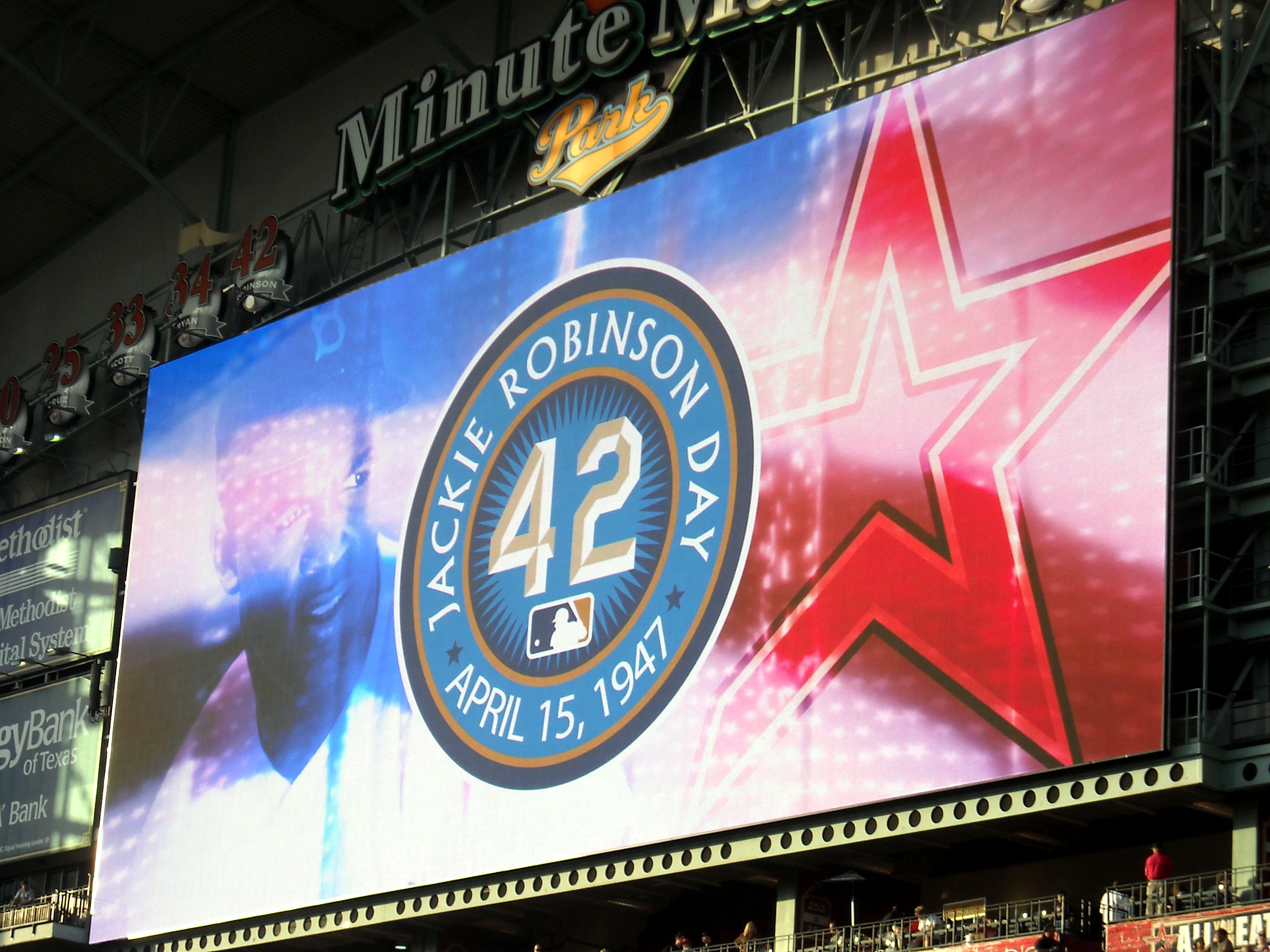
This past Monday was set aside by Major League Baseball to pay homage to an achievement of courage and determination as part of the annual Jackie Robinson Day.

Each year on April 15 Major League Baseball teams stop to remember Jackie Robinson. Photo R. Anderson
Each year on April 15 Major League Baseball teams stop to remember Jackie Robinson.
Photo R. Anderson

On April 15, 1947 Jackie Robinson became the first African American to step foot on a Major League Baseball field when he suited up for the Brooklyn Dodgers.

The world of baseball for Jackie Robinson, and many other players like him, was far different from the world of baseball today.

I am not referring to jumbo trons and jumbo hot dogs or any of the other things that have found their way into the modern game. I am not even talking about the designated hitter.

Prior to 1947 there were no minority players in the highest level of professional baseball. It took an owner willing to do what others wouldn’t in Branch Rickey and a player willing to withstand insults from on the field and in the stands in Jackie Robinson to pave the way for those that came behind them.

For people of a certain age, like me, it is nearly impossible to picture a segregated baseball diamond. From my earliest recollections there were people of all shapes and sizes and races on the field.

Jackie Robinson Day at Minute Maid Park.  Photo R. Anderson
Jackie Robinson Day at Minute Maid Park.
Photo R. Anderson

Look at the rosters of the 30 MLB teams today and one will find players from six continents.

None of that would have been possible without someone taking the first step to desegregate the diamond.

So it is fitting to take time to honor Jackie Robinson’s sacrifice and to ensure that generations who were not alive back in 1947 can learn the story and know that without the sacrifices of people like Jackie Robinson the world would be an entirely different place.

One of my favorite quotes is “Those who cannot remember the past are condemned to repeat it.” It was first stated in the early 20th century by George Santayana, but the phrase is still as true today as it was when first spoken. Society must continue to learn from history so as not to repeat the mistakes of the past.

Hunter Pence of the Houston Astros celebrates Jackie Robinson Day in 2011. Photo R. Anderson
Hunter Pence of the Houston Astros celebrates Jackie Robinson Day in 2011.
Photo R. Anderson

As another outlet to learn from the mistakes of the past this week also marks the release of the movie 42 which provides a big screen treatment of the momentous event and allows generations who were not alive in Jackie Robinson’s time to see what it was like.

As part of Jackie Robinson Day each player on every team wears the number 42 as a show of respect and solidarity. Of course one player still wears the number 42 every game but more on that in a bit.

While each team celebrated the moment in their own way the main celebration occurred in Los Angeles, CA where Jackie’s widow was in attendance at Dodger Stadium in Los Angeles.

During the annual celebration of Jackie Robinson there are always a select few who will state in various outlets that the inclusion of Jackie Robinson in the Baseball Hall of Fame was based solely on him being first to break the color barrier and is not reflective of his playing ability.

Of course, a quick look at his career statistics show that based on the merits of his play alone Jackie Robinson is every bit of a Hall of Fame caliber player and is included as much for what he did as a player as well as what he did as a trailblazer.

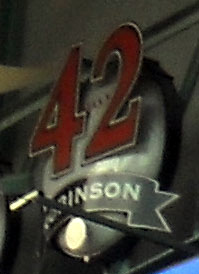
In 1997 all 30 MLB teams were told to retire the number 42 in honor of Jackie Robinson. Photo R. Anderson
In 1997 all 30 MLB teams were told to retire the number 42 in honor of Jackie Robinson.
Photo R. Anderson

In 1997 Major League Baseball retired the number 42 on all teams in honor of Jackie Robinson. As part of the retirement players who were still wearing the number were grandfathered in and allowed to keep wearing it for the remainder of their careers.

Currently Mariano Rivera of the New York Yankees is the only active player still wearing the number 42. Rivera is expected to retire at the end of this season so the number 42 will be officially retired 15 years after the announcement to retire it was made.

This means that starting in 2014, no player will ever again wear the number 42 in Major League Baseball. It is likely that the Yankees will retire Rivera’s number as well based on his impressive body of work. That will lead to the hanging of two 42 banners in Yankee Stadium with one for Robinson and one for Rivera. Then again the Yankees always did like to be a little different.

Of course this years celebration of Jackie Robinson Day was marred by the cowardly act of the Boston Marathon bomber.

At the time of the bombing only one MLB game had been completed with the Boston Red Sox and the visiting Tampa Bay Rays wrapping things up shortly before the first bomb was detonated.

The remaining MLB games Monday featured moments of silence for the victims of the attack. Acts like the bombing of innocent bystanders at the Boston Marathon show that the world is still as full of hate today as it was on that April day in 1947.

But just as was the case in 1947, there are still people willing to rise above the hatred and do what is right. And that is something worth remembering every day.

Now if you’ll excuse me, I am off to catch a screening of 42, perhaps I will see you there.

Copyright 2013 R Anderson