Space Cowboys and Commanders Leave Much to be Desired

Recently, two teams I have a lengthy history of supporting decided to change their names.

That fact alone is not that surprising. In recent years, teams changing their names has been a rather common occurrence with the reasoning behind the name changes running the gambit from bowing to pressure from outside forces, to wanting to freshen a brand to sell more merch.

In keeping with that tried-and-true model, in the latest example of the name game, one team changed their name due to outside pressure from groups who considered their old name to be offensive, and the other team changed their name for what can likely be called a money grab to force their fans to buy new merchandise and to put their special seal on a new asset.

In both cases, the new names left me feeling less than excited to continue rooting for either team.

The first example of rebranding gone bad is the Sugar Land Skeeters becoming the Sugar Land Space Cowboys.

If the team really wanted to pay homage to the Sugar Land past, they could have gone with calling the team the Imperials in honor of the rich history of Sugar Land as a producer of Imperial sugar. Instead they decided to play the role of the Joker.
Photo R. Anderson

Because when I think of a great name for a Minor League Baseball team I think, “hey let’s find a title from the Steve Miller Band’s catalog and go with that.” I suppose it could have been worse and they could have called them Maurice.

But all tributes to the Joker aside, Skeeters was a name that reflected the fact that this side of Texas is ground zero for the blood sucking insects.

The rebranding trying to tie the Space Cowboys to actual aerospace workers and the “old west” history of a Houston suburb just falls flat on so many levels.

If the team really wanted to pay homage to the Sugar Land past, they could have gone with calling the team the Imperials in honor of the rich history of Sugar Land as a producer of Imperial sugar.

Better still, they could have left well enough alone and built on the legacy of the Sugar Land Skeeters instead of feeling the need to create a new brand.

In many of my marketing and management classes the value of building on an existing brand was front and center in lessons on what good marketeers do.

Instead, of following those tried and true principles the team decided to rebrand mirror the Astros lest we forget that they are an affiliate of the Major League cheaters.

In addition to a really lame new name, one of my favorite mascots, Swatson, is being sent on an imaginary trip around the world with another former Skeeters mascot named Moe and being replaced by a blue space dog. Call me crazy, but wouldn’t the sidekick of a space cowboy be a space horse and not a space dog?

In addition to a really lame new name, one of my favorite mascots, Swatson, is being sent on an imaginary trip around the world with another former Skeeters mascot named Moe and being replaced by a blue space dog. Call me crazy, but wouldn’t the sidekick of a space cowboy be a space horse and not a space dog?
Photo R. Anderson

I mean I get that dogs are man’s best friend and all that, but a horse, or a cow, really would have sold the whole space cowboy theme a bit more unless the space dog is meant to corral all of the sheep into buying into the new name.

As part of the rebrand launch back stories were written for the new mascot as well as detailed descriptions of how the team colors and logo were designed. When a marketer has to spend several paragraphs justifying their actions one really has to question their own buy-in on the project.

Talk about the pompatus of self-righteousness.

Shortly after the news broke that the Houston Astros bought the Skeeters, I wrote a column noting that they would likely take something I considered special and turn it into something fit for a metal trash can, and in a little over a year they did just that.

Sorry Space Cowboys but this is one fan who will not be joining you on your new quest to get money from the citizens of Space City. I would rather cling to my good memories of Swatson and the Skeeters while taking my money and running away from your rebrand.

The second example of rebranding gone bad is the Washington Football Team becoming the Washington Commanders.

As noted before in several other columns, I was born outside of Washington D.C. and was a fan of the burgundy and gold from a very young age. I even have the Hogs nose to prove it.

While I will certainly concede that the team needed to move past their use of Native American branding, the Commanders just makes me think of a bad G.I. Joe cover band.

It also creates the issue that one usually would have a single Commander in Chief versus multiple Commanders. Or as the old saying goes, too many chefs ruin the soup.

I am not alone in thinking that the Commanders name fails to capture the imagination. Former players and fans alike have not been afraid to unleash the full fury of their displeasure about the new name on various social media platforms.

One of the early leaked new names for the Washington Football Team was the Red Wolves. Unfortunately for proponents of that name, the trademark was already owned by Arkansas State University.
Photo R. Anderson

I get that the team needed to find a name that they could trademark and make money off of. One of the early favorites for a new name was the Washington Red Wolves which would have allowed fans to keep singing a certain song by replacing the word “skins” with the word “wolves.”

Sadly, for that football team in Washington, Arkansas State University already held the trademark for Red Wolves. So, any thoughts of singing Hail to the Red Wolves in D.C. were quickly dashed.

I get that the Red Wolves fell out of the pack of potential names, but are we to believe that after nearly three years of trying to find a name that was not offensive and could be trademarked, the only options was Commanders?

The anticlimactic reveal of Commanders follows the news last year of the Cleveland Indians becoming the Cleveland Guardians which is another name that falls short.

As I noted last year in a column about the Guardians, there was already a team in Cleveland named the Guardians. So, not only did the Cleveland Indians brain trust come up with a less than stunning name based on some monuments on a bridge, they did not even do enough research to realize that the name was already in use in their own town.

One certainly hopes that after three years of searching the Washington Football Team at least verified that there wasn’t already a Washington Commanders franchise in town.

I realize that there are likely people who think that the Space Cowboys and Commanders are good team names. Some of those people may even not be employed by the two franchises that chose those names.

But for me and my time and money, I am not planning to give any thought to the Space Cowboys or the Commanders, since they are doing me wrong, doing me wrong.

Thanks for the memories, Swatson. I will always remember the times we shared at the Ballpark before the Astros came and ruined everything. Stay Gold Swatson. You will be missed.
Photo R. Anderson

I am not ruling out a return to the Ballpark in Sugar Land since my desire to see live baseball will likely overcome my disdain for the Space Cowboys name and a desire to not give any money to anything owned by the Astros.

But, if I do return to Constellation Field, I will either be wearing my Skeeters gear, or showing support for the Round Rock Express or Albuquerque Isotopes.

As far as the Commanders go, I will remember the glory days of my youth in a Maryland suburb where I led the Super Bowl cheers in elementary school. Those are enough Lovey-dovey, lovey-dovey, lovey-dovey all the time memories without tarnishing them by going commando for the Commanders.

Now if you’ll excuse me, I have a strange urge to listen to the Steve Miller Band.

Copyright 2022 R. Anderson

Bumper Stickers, Like Fortune Cookies, Can Guide Us on Our Path

Ah, the bumper sticker. That adhesive little piece of vinyl that provides endless opportunities to customize one’s ride.

By most accounts, bumper stickers have been around almost as long as there have been bumpers.

Some bumper stickers are meant to make us laugh.

Some bumper stickers are meant to inform people about a cause near and dear to the driver’s heart.

Some bumper stickers are even meant to serve as bragging rights for someone’s child who may have made an honor roll, or be part of a band.

Once upon a time, bumper stickers for radio stations were even used in the hopes that the driver would be spotted by a radio station employee and win a prize for their loyalty to said station.

Whatever the message being told, in most cases, someone made a conscience decision to buy the bumper sticker, and then place it somewhere on their car for the world to see.

Of course, sometimes a bumper sticker can silently guide one’s path without ever finding its way onto a bumper.

Such is the case of a humble piece of vinyl advertising that I picked up during a trip to the store with my aunt, grandmother and mom nearly 40 years ago. That piece of vinyl is a University of Florida (UF) bumper sticker.

Nearly 40 years ago, I picked up this bumper sticker at the end of a register at a five and dime store in Florida having no clue the role it would play in my life in the decades that followed.
Photo R. Anderson

Had I known at the time what that bumper sticker would lead me to, I likely would have made a bigger deal about it the day I got it.

Instead, the bumper sticker that I plucked from the Pic N’ Save Drugs register has quietly nudged me along from its place on a bookshelf in my life-long dream of becoming a Florida Gator.

To be fair, I did not pick up the bumper sticker because I thought I was setting my collegiate future in stone. Instead, I most likely thought that the colors were cool, or perhaps I just liked that it was free.

Back then, younger me loved to grab every brochure and other marketing material that I found. So, it very well could be that I was merely continuing that trend when I saw the stack of bumper stickers on the register.

Even though it would be nearly a decade before I would have a bumper to put the sticker on, and even more years after that before I would need to pick a college, for whatever reason, on that day I grabbed the bumper sticker and never looked back.

To me, that bumper sticker was more than just some mass-produced marketing collateral advertising a radio station, a drug store and a college football team on one 3” by 6” mosaic.

In the first seven to eight years of my life I was not really aware of college football. But thanks to that bumper sticker, I now had a college football team to root for and would spend many Saturdays in the fall glued to the television set watching the Jefferson Pilot Sports broadcasts of the Gators. Once Steve Spurrier brought the Fun n’ Gun to town, my fandom of the Gators went to a whole new level.

Thanks to a chance encounter with a bumper sticker, I spent many Saturdays glued to the television watching the Jefferson Pilot Sports broadcasts of Florida Gator football games. Once Steve Spurrier brought the Fun n’ Gun to town, my fandom of the Gators went to a whole new level.
Photo R. Anderson

As I grew older and started to become interested in journalism, the bumper sticker reminded me that the University of Florida had a really good journalism program and alumni like Bob Vila and Bob Ross.

Local media personalities I followed in Orlando were also Gator alum, which made me think that if I wanted to be a serious journalist in Florida I best become a Gator.

Ultimately, despite touring the campus with my parents and being thrilled that the College of Journalism and Communications was across the street from the football stadium, my undergrad collegiate career did not end up in Gainesville.

Instead, I stayed close to home and went to a two-year community college 20-minutes from home, before enrolling at the University of Central Florida (UCF), which I could literally see from my parents’ house.

When the Gators won the National Football Championship during my junior year at UCF, I was briefly bummed that I had not been there to take part. In my mind, I would have been a sports reporter for the UF student newspaper and have spent many days interviewing Coach Spurrier about the finer points of the Fun n’ Gun offense.

Instead, I was at UCF blazing a course that I would not have otherwise had. At UCF, I was able to start and run my own newspaper, which is something I would likely not have gotten to do at UF.

I was also able to see UCF grow from a small commuter university trapped in the shadow of the three dominant Florida schools, to the largest university in the country in terms of enrollment and one that routinely best those three “legacy” Florida universities in academics and athletics.

While my undergrad studies did not involve interviewing the ‘Head Ball Coach,” at UCF, I interned in the Sports Information Office and played a vital role in the school’s transition to compete in the highest level of collegiate athletics.

I do not regret choosing UCF over UF one single bit. I am proud of my UCF degree and all of the friends, memories, and experiences that came out of it. I am also proud of my years of service in supporting UCF alumni causes as both a donor and a board member. That will never change.

Still, that bumper sticker remained on my shelf reminding me that, although I did not get my undergrad degree at UF, I could always try to get a graduate degree from there.

After moving to Texas, I even applied a few times for various online programs at UF, but life always seemed to get in the way and I never followed through with enrolling.

Despite not being a UF student, I remained a fan of UF athletics and cheered loudly whenever the Gators were on television. On special occasions, I even enjoyed the Gators in chocolate chip cookie cake form.
Photo R. Anderson

Despite not being a UF student, I remained a fan of UF athletics and cheered loudly whenever the Gators were on television.

Afterall, my fandom of the Gators had about a 10-year head start on my fandom of the Knights thanks to that bumper sticker.

So, I resigned myself to the fact that I would likely never be a real Gator, in the same way that Pinocchio likely thought that as hard as he wanted it to be so, he would never be a real boy.

But Jiminy Cricket, that bumper sticker still had me wishing on that Gator star whenever I would dust it on my shelf.

Dreams are a funny thing; they don’t really have an expiration date as long as one continues to believe in them.

So, despite getting a Masters Degree in Sport Management from HBU during the heart of the COVID-19 pandemic, my dream to be a Florida Gator continued to burn deep inside me. So, I decided to apply to UF once more.

Today, is the first day of class for me as a student in the College of Journalism and Communications at the University of Florida. It has been a long and winding road to get here, but I am here nonetheless and could not be more excited.
Photo R. Anderson

And while I had hoped to start in 2021, today, is the first day of class for me as a student in the College of Journalism and Communications at the University of Florida.

It has been a long and winding road to get here, but I am here nonetheless and could not be more excited.

As I stare at the bumper sticker that started it all for me so long ago from its new frame on my wall, I have but one thought which is, “man, I am so glad that it wasn’t a Florida State University bumper sticker at the end of that Pic n’ Save register.”

Now if you’ll excuse me, I have some schoolwork to get to, and in the words of that life altering bumper sticker, “Go Gators!”

Copyright 2022 R. Anderson

Taking a Trip Down Memory Lane one Story at a Time

Recently, I decided that I needed to create an online portfolio to feature some highlights of my journalistic career.

Okay, so I actually decided years ago that I should upgrade my file system from retaining photocopies of articles I’d written in three-ring binders, to displaying them in an online portfolio, but recently I made the decision to stop procrastinating and finally get it done.

Trying to decide what to highlight from a lengthy career can be a monumental task no matter which side one tries to attack it from as I discovered shortly after kicking off the portfolio project.

After years of procrastination, I have finally decided to crack open the dusty black binders under my desk and build an online portfolio highlighting my journalistic career.
Photo R. Anderson

In the movie Mr. Holland’s Opus, the main character, who for simplicity’s sake is conveniently named Mr. Holland, sets out to write his definitive opus that sums up his entire career in one magical musical number.

While I have not yet entered the territory of trying to build a Mr. Holland’s Opus style career spanning master work, I must admit I can see the exit to Opus town from my desk, and if I hold my ear against the window, I am pretty sure that I can hear some faint sounds of oboes and French horns off in the distance.

What I first envisioned to take no more than a weekend to build has definitely multiplied and taken a life of its own as I now try to meet my revised goal of unveiling the portfolio by the end of the year.

Along the way, sprinkled in with the frustration of trying to choose the perfect background color for each section of the portfolio, I have been taken on a journey down memory lane by rediscovering some old stories that quite honestly I had forgotten about.

While there may have once been a time when I remembered every single story I had written, the truth is that as the number of years and number of stories grows one simply cannot remember every single article and feature story.

There are also a few stories that are not worth remembering. The want to forget stories usually involved an editor telling me to go interview so and so at such and such company because they just bought a quarter page ad in the paper.

My inner journalistic compass always hated those pay per play style stories, so they are ones I have tried very hard to forget. Thankfully there are only a handful of those type of stories in my archive.

Another discovery I made while digging deep into my archive is the realization that somewhere along the way between the time when many of the older articles were written and now, I quietly morphed from the young curious reporter fresh out of Journalism school who was determined to change the world for the better with my writing, to the older and wiser reporter going back to Journalism school and still determined to use my God given talents to make a difference in the world through my writing.

Or to put it in Big Head Todd and the Monsters language, “Rise and fall turn the wheel ’cause all life is Is really just a circle.”

Whether they are stored in dusty attics, in three-ring binders under a desk, on microfiche, or in online portfolios, newspaper articles capture a very definitive moment in time acting like a time capsule. It is easy to go back and read the articles and think that things remained constant like a proverbial snow globe capturing a single scene for all eternity.

And while some things may still be the same as they ever were, one cannot help but accept the fact that the hands of time are constantly turning and the people and events from the story did not cease existing once their essence was captured in print.

While many stories merely reflect a moment in time, sometimes an interview subject leaves a mark long after the story has gone to print as was the case with a story I wrote back when I was an undergraduate student at the University of Central Florida. I had the chance to interview a 75-year-old great grandfather named, Elmer Kundinger, who was returning to school after what he called a “50-year Spring Break.”

Back when I was an undergraduate student at the University of Central Florida, I had the chance to interview a 75-year-old great grandfather named, Elmer Kundinger, who was returning to school after what he called a “50-year Spring Break.” When I decided to go back to school to get my Master’s degree after a 20-year break, I thought about Elmer.
Photo R. Anderson

When our paths crossed, Elmer and I were in decidedly different phases of our lives, but in the years since that interview Elmer was one of those stories that I would often think about.

In fact, when I decided to go back to school to get my Master’s degree after a 20-year break, I thought about Elmer.

Back in 1995 when I asked him what motivated him to return to school after a 50-year hiatus Elmer responded by saying, “this is just a personal satisfaction goal that I have set aside for myself, and fortunately what the mind thinks about sometimes is what happens.”

At the end of our time together Elmer noted that “Some of the happiest moments of my life are going on right this second. Everything is really coming up roses. All I have to do now is stay alive.”

When I went searching to see what Elmer was up to shortly after my own return to school, I had feared that I would find his obituary, but was happy to see that he was now 101 years old and had even gone back and gotten a second degree since the time I had last spoken with him.

That is part of the magic of journalism, and in particular feature writing. Every single person has a story to tell that his just waiting to be discovered.

On the silver screen in 1995, Mr. Holland wanted to write his Opus to put a coda on his life and sum up all of his accomplishments with an epic orchestral number.

Meanwhile, at the same time on the campus of a college in Orlando, FL. in the real world, Elmer Kundinger showed that one is never too old to start new things, or to complete lifelong goals.

Personally, I would much rather live like Elmer always looking for new opportunities and ways to find enrichment and to enrich others instead of taking a self-centered Mr. Holland approach of thinking I can rest on my laurels if I create a single masterwork.

For me, creating a portfolio is a reminder of what I have already done and a way to reconnect with some old memories from interviews gone by while also leaving room for all of the things I am still yet to do.
Photo R. Anderson

For me, creating a portfolio is a reminder of what I have already done and a way to reconnect with some old memories from interviews gone by while also leaving room for all of the things I am still yet to do.

There are so many stories left to write and new adventures to be had.

One might go so far as to say that the future is so bright I gotta wear shades.

Completing my online portfolio and continuing to bring stories to life is my own “personal satisfaction goal.”

Whatever your own goal may be, I wish you success in achieving it.

Now if you’ll excuse me, I need to get back to finding stories to add to my online portfolio after I tell the person outside my window to stop playing the oboe so loudly.

Copyright 2021 R. Anderson

College Football set to Kick off during a COVID-19 Pandemic for Second Straight Year

It has been said that the definition of insanity is doing the same thing over and over again and expecting a different result.

I used that line in a column last September to describe the absurdity of trying to play football during a global COVID-19 pandemic.

When I wrote those words, and the 1,000 plus other words in that column, I never dreamed that a year later we would be basically back in the same spot.

In 2021, just as in 2020, we are still dealing with raging COVID-19 outbreaks. People are still denying science. Governors are still saying vaccine and masks mandates infringe on one’s freedom to spread the virus to others. Plus, so much more bologna that I really thought we would be done with by now.

Instead of using last year as a rallying cry to do everything we could to send COVID-19 packing, here we are with an even more potent variant of COVID-19, and even less restrictions on activities that could help slow the spread of the disease.

The horse is definitely out of the barn when it comes to COVID-19 denialism. Speaking of horses, some people now would rather take a horse deworming medication, that does nothing to prevent or treat COVID-19, instead of taking a fully approved vaccine that can prevent infection, hospitalization and death in most cases. I guess horse dewormer is the 2021 version of 2020’s advice from a fan of red trucker hats to ingest bleach like a cleaning.

The fact that the United States Food and Drug Administration (FDA) once again had to send a common sense tweet out reminding people not to take horse medicine a year after tweeting not to ingest bleach shows just how out of touch from reality some parts of society are.
Graphic R. Anderson

The fact that the United States Food and Drug Administration (FDA) once again had to send a common sense tweet out reminding people not to take horse medicine a year after tweeting not to ingest bleach shows just how out of touch from reality some parts of society are.

I really wonder what type of person decides that they would rather get a horse paste at the local feed store instead of rolling up their sleeve and getting a vaccine.

I picture the conversation going something like this:

Chet: Hey Bob, did you see that anonymous post on Facebook the other day about the benefits of horse deworming cream to fight that fake virus?

Bob: I did. I am giving it a try since I can’t seem to shine this light down my throat like a cleaning. I’m so glad we have random posts on Facebook from people with zero medical training to give us the truth, compared to those scientists who spent years studying infectious diseases and are dedicated to keeping people safe.

Chet: Agreed, see you at the completely full football stadium on Saturday for the mask burning. I will save you some nachos.

And scene.

Shame on me for giving certain segments of society more credit than they deserve. I know I should know better, but sometimes I just cannot help myself. I want to believe that society can improve, instead of just racing like lemmings towards the cliff lowering the bar as they go.

We really are trying our best to make the world outlined in the movie Idiocracy become reality.

In the movie Idiocracy an American soldier who is accidentally frozen for 500 years as part of a military experiment wakes up in a dystopian world where society has forgotten the ideals of intellectual curiosity, social responsibility, justice, and human rights and instead society has embraced commercialism and instant gratification. Sound familiar? One need only watch the news for a few hours to see that in many ways we are well on our way to bringing that vision of society lampooned in the movie to life.

I have written about Idiocracy a few times before, but for anyone unfamiliar with the plot of the 2006 Mike Judge movie, it goes something like this.

An American soldier who is accidentally frozen for 500 years as part of a military experiment wakes up in a dystopian world where society has forgotten the ideals of intellectual curiosity, social responsibility, justice, and human rights, and instead society has embraced commercialism and instant gratification.

Sound familiar? One need only watch the news for a few hours to see that in many ways we are well on our way to bringing that vision of society lampooned in the movie to life.

When a disruption in a state’s power supply caused by inept governmental leadership triggers a worldwide plastic wrap shortage, one has to wonder just how many degrees of Kevin Bacon we are from totally collapsing as a society.

Especially when that state that sounds like “Texas” focuses more on passing executive orders and bills to suppress masks and voting rights then actually trying to fix the flawed power grid before the next cold snap, or heat wave, once again leaves thousands of people without electricity in a state that literally pumps the natural gas out of the ground that powers many of the electric plants.

But I shall rant about the failings of the “do it on our own star state” at a later date, today my attention is focused on the gridiron as college football season kicks off this week.

As noted time and time again, I enjoy college football. Aside from being a long-time fan of the game, during my undergraduate studies I interned in a college Sports Information Office and spent many a Saturday in the press box of college football games.

Additionally, I worked for five years with a committee that was responsible for hosting three college bowl games a year.

While I enjoy college football, I do not enjoy it to the point where I want to see stadiums full of people cheering in the middle of a pandemic. I also really have zero desire to attend a watch party for a college football game in the middle of a pandemic.
Photo R. Anderson

While I enjoy college football, I do not enjoy it to the point where I want to see stadiums full of people cheering in the middle of a pandemic.

I also really have zero desire to attend a watch party for a college football game in the middle of a pandemic.

Sadly, an organization I volunteer with does not share my belief that now is not the time for college watch parties and has basically said, “go have your parties, and if you have high transmission of COIVD-19 where you live, have the watch party outside.”

Because yeah, having people shouting at a football game and stuffing their faces full of nachos and other salty snacks is a great idea in the middle of a pandemic.

Navigating the latest surge of COVID-19 boils down in many ways to an individual’s risk versus reward threshold. While vaccinated people certainly can be riskier in theory compared to unvaccinated people, the simple fact remains that even vaccinated people can get breakthrough cases.

This brings me to my Dirty Harry approach to navigating COVID-19. Whenever I am thinking of going to an event, I squint really hard while gritting my teeth and recite the following mantra to myself to determine my willingness to participate in said event.

“Ryan (That’s what I call myself in my head), I know what you’re thinking. ‘Is the entire group vaccinated or not’? Well to tell you the truth, in all this excitement, I kind of lost track of everyone’s vaccination status, and because this is an anti-science state, I am likely to get shot if I ask the wrong person to see a vaccine card. But being that we are talking about the Delta variant, the most contagious COVID-19 variant in the world, that is putting more people in the hospital than any other variant combined, you’ve got to ask yourself one question: ‘Do I feel lucky?’ Well do ya, punk?”

Once I have weighed the pros and cons of an event I react accordingly.

Getting on an airplane full of masked people so I can visit family in Florida is an activity I can get behind on the Dirty Harry do I feel lucky scale.

Watching college football in person either in a stadium, or at a sports bar, just does not give me a reward that is greater than the risk. Or in Dirty Harry speak, it does not make my day.

More power to those who want to partake in such things, but at the end of the day college football is not essential to society. Furthermore, if large crowds attending games is straining the health care systems in those mostly red football loving states, then that is a huge problem.

After going fan free during the 2020 College football season, ESPN’s College Gameday kicked off the 2021 season with crowds reminiscent of the before times proving that profit trumps pandemic in the eyes of some despite more people being hospitalized from the Delta variant of COVID-19.
Photo R. Anderson

In several states healthcare workers are walking away from their jobs in record numbers citing burnout, as well as not wanting to continue to risk their lives to take care of an unvaccinated population that thumbs their nose at science.

Other states are so full of COVID-19 patients in their ICU departments that there is no room for patients who have non-COVID emergencies requiring hospitalization.

It does not help the cause when governors ban masks mandates and instead just say that they will import more healthcare workers into the state to handle the surge within the hospitals.

That would be like someone in a sinking boat continuing to bail out water with a bucket with a hole in it instead of getting on the Coast Guard cutter that came to save them while saying, “Nope, I can’t have the federal government infringing on my freedom to stay on this sinking boat. You can keep your shiny government funded rescue craft. I’d rather just keep bailing here by myself.”

Unfortunately, that seems to be the mantra some governors are urging their citizens to follow. Don’t wear a mask, don’t get a vaccine if you feel it infringes on your rights, and if you get sick just take some gene therapy that is only available in short supply.

Or, one can always take that aforementioned horse deworming cream of course. Shudder.

The anti-mandate politicians are quick to say, “Don’t worry if your actions cause kids who are too young to get vaccinated to get sick. They would rather die free then live in a mask anyway.”

Of course, these are the same politicians who so famously said during the power grid failure that “many Texans would rather freeze to death then count on other states for their power,” or heaven forbid pay more for electricity.

I am sure there is a conspiracy theory out there somewhere in the dark corners of social media amongst the posts about the medicinal properties of horse paste that says that getting power from a blue state will either make you turn blue, or brainwash you into turning in your guns.

Seriously, are there massive radon gas leaks somewhere that are causing so many people to lose touch with common sense and realty?

The Roman emperor Nero is credited with playing the fiddle and watching Rome burn around him. I suppose the modern-day equivalent would be people choosing to watch college football, or crowd into other spaces mask-less and unvaccinated while COVID-19 burns around them.

With comparisons to Nero fiddling as Rome burned around him, college marching bands may want to add a violin section to their halftime show to portray the reality of playing football in the middle of a global pandemic.
Photo R. Anderson

I guess more college marching bands should add violins to their ranks and start playing the “Devil went down to Georgia” during halftime like the Florida State Seminoles Marching Chiefs did years ago.

Idiocracy predicated what the future would look like in 500 years. At the current rate we likely won’t have to wait that long until society totally devolves. I guess that is good in a morbid way, since at the rate we are destroying the planet there is no guarantee that the earth will even be around in 500 years.

Now if you’ll excuse me, I think it is time for another screening of Idiocracy.

Copyright 2021 R. Anderson

If Only MacGyvering a Solution to Life’s Problems with a Swiss Army Knife and Duct Tape Worked for Global Conflicts

As first noted in a column nearly eight years ago one of my favorite television shows growing up was MacGyver.

I enjoyed the show so much that I even dressed up as MacGyver for Halloween one year. Additionally, I have carried a Swiss Army knife that I got for Christmas in my pocket for over 35 years since, one never knows when it will be needed, as noted in my first MacGyver column back in 2013.

Inspired by my love of the television show MacGyver, Old Red has been in my pocket for over 30 years.
Photo R. Anderson

Sure, it could be easy to say that I liked MacGyver because the actor playing the title character and I shared the same haircut, last name and love of Swiss Army knives, but a better explanation for the show’s appeal was the way that difficult problems were solved using simple household items, elbow grease and brain power.

To be clear I am talking about old school Richard Dean Anderson MacGyver, and not that rebooted version of MacGyver that came out a few years back.

The show was instrumental in showing that science and brainpower could often overcome firepower so there was a positive message being presented as the Cold War was drawing to a close.

As I was watching the recent news coverage of the fall of Afghanistan, I was reminded of the Season One MacGyver episode called To be a Man. You know the one where MacGyver travels to Afghanistan and battles wits with Soviet backed forces.
Photo R. Anderson

As I was watching the recent news coverage of the fall of Afghanistan, I was reminded of the Season One MacGyver episode called To be a Man.

For those readers who may be too young to remember, before the United States tried to reshape Afghanistan, the Soviet Union gave it a go back in the 1980s.

The issue of Soviet occupied Afghanistan was addressed by Hollywood in such films as The Living Daylights, Rambo III, and Charlie Wilson’s War to name a few.

In The Living Daylights, which came out in 1987, James Bond, played for the first time by Timothy Dalton teams up with Mujahadin freedom fighters to battle the Soviets and even manages to blow up a bridge by dropping a bomb from the cargo hold of a moving airplane to help the freedom fighter escape the Soviet forces.

A year after James Bond defeated the Soviets, Hollywood once again took a swing at the conflict using another film franchise. In Rambo III, Rambo, played by Sylvester Stallone, heads to Afghanistan to rescue his former commander and his longtime best friend, Col. Sam Trautman, from a Soviet Army colonel.

During the mid to late 80s many shows and movies took aim at the Soviet occupation of Afghanistan for plot inspirations. One such cinematic take involved sending Rambo into the rocky countryside to rescue his former commanding officer and to prove that Rambo knew how to ride a horse. If only Adrian could have seen him. Oh wait, wrong franchise.
Photo R. Anderson

This should not be confused with the plot of Rambo II where, Rambo battles Soviet troops in Vietnam and has to rescue prisoners of war.

Back to Rambo III, our hero of uttering words with few syllables manages to rescue his mentor and help a local band of Afghan rebels fight against Soviet forces who are threatening to destroy their village.

Chalk two up for the fictional good guys.

Using the fresh lens of the 21st Century, and with the United States six-years into what would turn into a 20-year war in Afghanistan, the 2007 movie Charlie Wilson’s War, starring Forrest Gump, I mean Tom Hanks, and Julia Roberts, told the true story of how the United States came to be involved in the 20th Century conflict by siding with the Afghan people in their fight against the Soviet Union through unofficial channels.

Of the three movies, Charlie Wilson’s War is likely the best reflection of the conflict between the Soviets and the Afghan people but it lacks that certain Swiss Army inspired wit.

That is where the man, the myth, the MacGyver enters the picture.  Of course, MacGyver was in Afghanistan before Mr. Bond, James Bond and Rambo. In the 1986 episode To be a Man MacGyver finds himself on a secret mission in Afghanistan to retrieve a downed satellite before it falls into the hands of the Soviets. While on the mission, MacGyver is shot and wounded. An Afghan woman and her son risk their lives to nurse MacGyver back to health.

To repay their kindness, a wounded MacGyver must now outwit the Russian Army to complete his mission and ensure the safety of the mother and her son by helping them cross the border into Pakistan.

While MacGyver was a work of fiction, I could not help but think of how so many Afghan citizens who risked their lives to help the American forces over the past two decades now face an uncertain future as they try to seek refuge in another country to avoid being killed by the Taliban.

In fact, in each of the films and television shows from the 80s dealing with Afghanistan the Americans, and in James Bond’s case, the British were the clear good guys helping  rescue people in need. Sadly, reality is often not as noble as Hollywood scripts.

According to government officials there are plans to provide safe haven for thousands of people who worked with the United States troops over the past two decades, but the speed of the retreat and leaving of Afghanistan has many wondering whether there is enough time to get everyone out according to the timeline laid out in those plans.

As the graph above illustrates, the more things change in Afghanistan, the more they stay the same. With the withdrawal of US forces, the Taliban once again are there to fill the void as the did following the retreat of Soviet forces in the late 20th Century.
Graphic R. Anderson

While there will likely be future movies that address the United States’ withdrawal from Afghanistan, and all of bad optics that followed, one need only watch the news each night to see the accounts of so many people suffering as the vacuum left by the departure of the United States gets filled by the Taliban.

I am not going to get into the politics of whether we should have gone to Afghanistan in the first place, or if we should be leaving when we are. There will be plenty of time to cover that in the years ahead.

The United States joins a short list of world powers who tried and failed to change Afghanistan.

In the 19th Century it was the British. In the 20th Century it was the Soviet Union, aka modern-day Russia.

And, in the early 21st Century it was the United States trying to imprint a vision of a path forward on a country that seems like it does not really want outside help.

While the world continues to battle a health pandemic it is now faced with a potential expanded refugee pandemic brought about by the rapid fall of the government of Afghanistan and the return to power of the Taliban.

Although I am steering clear of the politics, and the blame game, following the departure of United States forces, I feel I must comment on the stories being floated in certain circles about the refuges from Afghanistan “invading people’s towns.”

The “they are coming for your jobs and your wives” narrative is a common response from people who are trying to sow fear about anyone who doesn’t look and talk like them.

It is not based in reality, and only shows the ignorance of the people who both peddle in such nonsense, as well as those who fall for it.

There are bad people of all races, creeds and religions, so trying to lump all refuges from any place as criminals and rapists is just flat out wrong.

In terms of knowing refugees from Afghanistan, I have some experience on that subject.

When I moved to Florida in the third grade, I met Omar. Omar’s family fled Soviet occupied Afghanistan and settled in Florida, which could not have been easy for them.

Omar was in Ms. Taylor’s class with me and was one of my best friends from third grade through high school. Omar lived a few streets over from me and was someone I spent a lot of time with.

We sat together on the school bus through middle school and freshmen year of high school. Once I started driving to school, I would often give Omar and other friends rides home.

Sadly, as is too often the case, I lost touch with Omar shortly after college.

I had many friends from many different backgrounds throughout my life and they helped share their cultures and traditions with me which in turn made me a more rounded person as a result.

Sadly, too many people seem to only want to hang out with people who look, talk and think just like them. That isolationist approach helps lead to breeding grounds of group speak and misinformation where someone on TV can claim that all refugees are bad, and the sheep will believe it without giving it a second thought.

As a quick history lesson, unless someone is 100 percent Native American, everyone living in the United States comes from an immigrant and/or refugee background. Some people’s ancestors immigrated here by choice, while others were forced to come here against their will.

Regardless of what brought them here, the simple fact remains that the United States was built by immigrants and refugees.

On the big and small screen, James Bond, Rambo, Charlie Wilson and MacGyver all fought their battles and won for the most part in under two hours.

In the current unfolding story, the quest for a crisp solution and happy ending for the good guys in the latest Afghanistan chapter seems a little cloudier and more complicated.

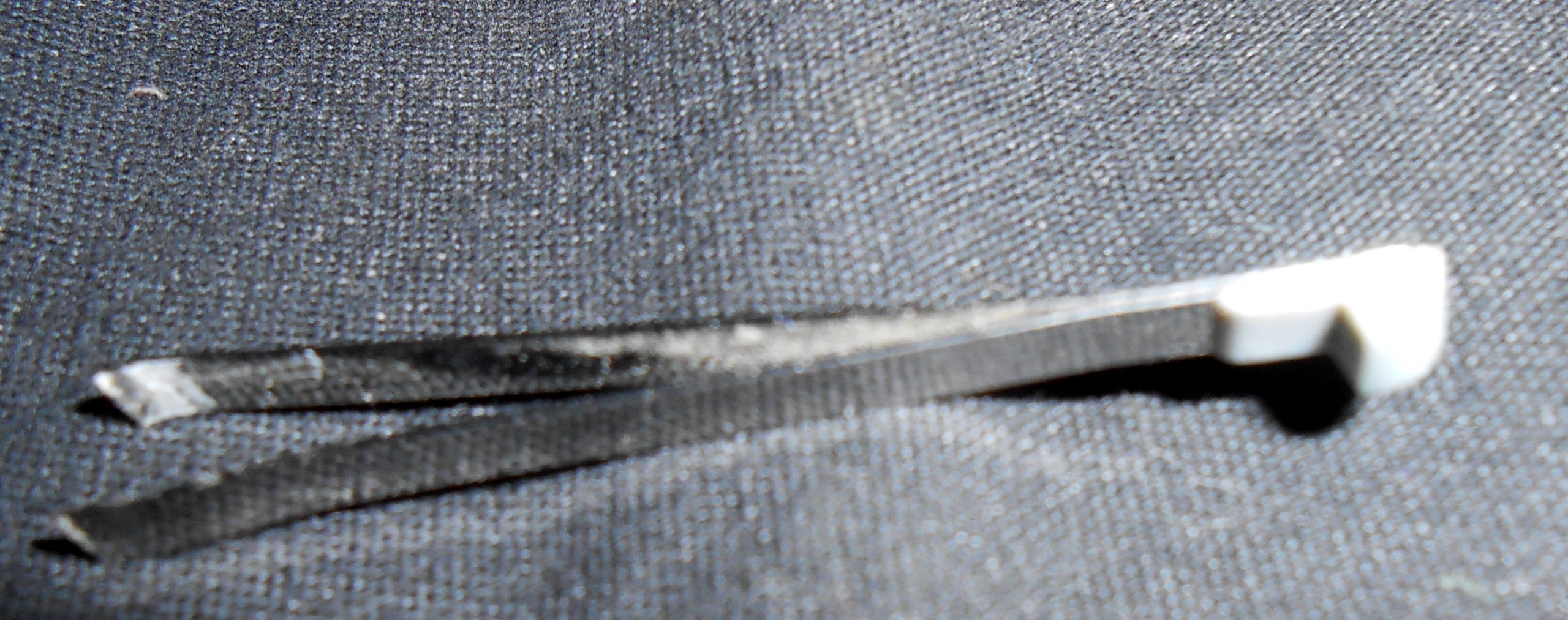
In a pinch, tweezers from a Swiss Army Knife can be used to fix loose screws on a pair of sunglasses. Unfortunately, they are not as good at solving geopolitical issues.
Photo R. Anderson

If only, reality was as simple as being able to solve the problems of foreign conflicts with gadgets from Q Branch, a bow and arrow and some grunted dialogue, a secret slush fund for black ops, or a Swiss Army knife and some duct tape.

If history is any indication there will likely be more outside forces that come to try to tame Afghanistan in the coming years. Of course, it seems unlikely that they will succeed where so many others have failed.

The current conditions in Afghanistan are both troubling and a tragedy, but they certainly should not have been a total surprise to any students of history. After all, those who fail to learn from the mistakes of history are destined to repeat them.

Now if you’ll excuse me, I have the urge to watch some old episodes of MacGyver after reaching out to an old friend. Where did I put that MacGyver wig anyway?

Copyright 2021 R. Anderson

Covering the world of baseball one pitch at a time.