Southpaw Flashback: With Great Fame Comes Great Responsibility; or Does It?

Editor’s Note: For the remainder of June we will be counting down our 10 favorite columns as we celebrate summer vacation. Coming in at number 3 on our countdown is a column from February 6, 2013.

We are a society that enjoys placing people on pedestals.

Whether it is actors, athletes, or any number of other categories, people who possess certain skills are often elevated above the rest.

As long as the elevated people behave in the manner that the masses below expect there are no issues.

But, once they start to slip, the lofty spot gets a little wobbly ahead of the inevitable crash back down to earth.

As a youngster, I had a few role models/heroes from the Baltimore Orioles. I would watch these players and coaches on the television each night. Despite them being broadcast in my living room every day, all I knew of them was the persona that was projected through the television screen and sports page.

These were the pre-internet years and still part of the time when the media didn’t feel the need to report every aspect of a person’s private life.

So, the elements that were broadcast were largely related to actual performance on the field. If a player happened to go home with someone other than his wife after a game, or went to a bar until it closed, it was not blasted across the sports section the next day.

The media considered it their job to cover the game between the lines and anything else was considered a personal matter between the player and his family and not something to be broadcast across the wire for the world to see.

This relationship tended to bond the players and the media together, as did the countless hours that members of the media spent traveling with the players.

It was not that the reporters were withholding information from the public, it was that they respected that the athletes were flawed people like the rest of us. As such,  there was no need to air dirty laundry that was not related to their jobs.

Sadly by the time I entered the profession, the 24-hour news cycle was already in place. With the arrival of around the clock coverage,   players lost some of their privacy forcing reporters to dig deeper into stories that were not really stories leading to a tabloidization of the sports section.

I would love to think that we would grow tired of trash journalism and return to a more noble way to handle things. Sadly, that genie has been out of the bottle for far too long to go back now.

Adding to the difficulty of returning to simpler times is the fact that we have generations of people who don’t know any other way to do things.

Frank Robinson at Tinker Field 1986
Frank Robinson at Tinker Field in Orlando, Fl. in 1986
Photo S. Quandt

A few years back, okay a decade or two back, my mother picked me up from school to go see a Spring Training game for my birthday.

This particular game featured the Baltimore Orioles and the Minnesota Twins.

We arrived early at the ballpark and as we were reaching our seats Hall of Famer Frank Robinson came out to the wall where people were signing autographs. I took my game program over and waited to get his signature.

Instead of moving through the line of children that were waiting, Mr. Robinson proceeded to flirt with a pair of women and totally ignored the waiting children.

And while this event happened over 25 years ago, the memory is still as fresh today as it was then.

While Frank Robinson had every right to not sign the autographs, the manner in which he left me and the other kids waiting left a lot to be desired.

He could have just said, “sorry kids, I don’t sign autographs” and we would have gone back to our seats but for this “role model” to totally ignore his fans was not the best way to handle things.

Actress Natalie Portman has famously said on numerous occasions that she is not a role model, and that her celebrity alone for doing her job does not make her feel any additional pressure or responsibility to all of the people who look up to her.

While Natalie is right, what is it that makes people look up to celebrities and athletes and consider them role models?

For me, I consider a ball player who plays the game the right way and doesn’t get caught up in scandal a person I can respect.

Of course, it is getting harder and harder to know who to respect thanks to almost daily reports of players who were either caught using, or suspected of using steroids and other banned substances to get an advantage over the competition.

Often times it is a no brainer to catch the cheaters. There was never any doubt in my mind that Barry Bonds, Mark McGuire, Sammy Sosa, and Alex Rodriguez had a slight advantage that perhaps was pharmaceutical based when they were posting their monster numbers and crashing through the record books like a runaway train.

While certain players make it easy to determine guilt or innocence through failed drug tests and other means, the line between guilty or not guilty of Performance Enhancing Drugs, or PED use is a little murkier for some.

Another player caught up in the web of suspicion of using PED’s was Roger Clemens.

While only “The Rocket” knows for sure what he did and didn’t take, I, and a federal jury, do not believe that he took anything that was illegal to gain an advantage.

Do I think that he is a good role model? Not really based on some of his off field activities.

Despite not considering Roger Clemens a role model, I do respect the way he played the game and the dominance that he showed on the mound for decades.

Despite being cleared by a jury in a perjury trial, Roger Clemens will face an uphill climb in his bid to gain entrance into the Baseball Hall of Fame.

Logic says that based on his career numbers and the legal victory he should be a lock for Cooperstown.

But after failing to gain entry on the first ballot, it appears the voters have a different take on the matter. the being deemed guilty by association tag will follow him for years to come.

Photo R. Anderson
Cal Ripken, Jr. at Baseball City Stadium in 1991.
Photo R. Anderson

One player that I followed that always seemed to play the game the right way, and never got into any controversy was Cal Ripken, Jr.

Cal was the longtime shortstop and third baseman for the Orioles.

Cal played all of his 21 seasons with the Orioles and became known as “The Iron Man” for breaking Lou Gehrig’s 56-year-old record of 2,130 consecutive games in 1995. Cal would extend his record by playing in 2,632 consecutive games overall before missing a game for the first time in 1998.

To put things in proper perspective, from 1981 to 1998 Cal Ripken, Jr. did not miss a single day of work. Granted, work consisted of playing baseball from April to September. So, one could argue he had around half of the year off.

Still, I am not sure there are many people in any profession who can say that they have gone that long without missing work for vacation or sick days, etc.

I looked up to him for the way he played the game and the quiet manner in which he approached things while amassing some huge numbers for his position.

Cal Ripken, Jr. has also written several books on how to play the game and in his retirement is active in placing ballparks in underprivileged areas to ensure that everyone has access to quality baseball fields.

So do players and other celebrities bare a responsibility to be role models?

It is hard to say.

Is Natalie Portman correct in her assessment that she just does a job and people need to leave her alone, or should ballplayers and other celebrities be expected to be more like Cal Ripken, Jr. and continue to give back after their playing days are done?

I like to think that players would want to be someone that is worth looking up to, but I also know it is the media and the public’s responsibility to identify people who are worth emulating, and those who have behavior traits that should be ignored.

Do I realistically think that this approach will ever come to pass? I like to think that I am optimistic about most things, but must admit a large dose of pessimism on that regard.

It seems we have now entered a phase where pedestals are built to be broken. While we tend to honor people who build themselves back up after the fall, it also seems like many people are knocked down just for sport, and the people who just go about their business without drawing excessive attention to themselves are ignored.

Now if you’ll excuse me, I think younger me needs to come to terms with Frank Robinson giving him the brush off.

Copyright 2013 R. Anderson
 

Southpaw Flashback: Impacts of a Brave First Step Still Being Felt

Editor’s Note: For the remainder of June we will be counting down our 10 favorite columns as we celebrate summer vacation. Coming in at number 4 on our countdown is a column from April 17, 2013.

We are a country that enjoys commemorating achievements in all shapes and sizes. Some call it the American spirit while others might call it an attempt to ensure that the sacrifices of those that have gone before us are remembered long after they are no longer walking amongst us.

This past Monday was set aside by Major League Baseball to pay homage to an achievement of courage and determination as part of the annual Jackie Robinson Day.

Each year on April 15 Major League Baseball teams stop to remember Jackie Robinson. Photo R. Anderson
Each year on April 15 Major League Baseball teams stop to remember Jackie Robinson.
Photo R. Anderson

On April 15, 1947 Jackie Robinson became the first African American to step foot on a Major League Baseball field when he suited up for the Brooklyn Dodgers.

The world of baseball for Jackie Robinson, and many other players like him, was far different from the world of baseball today.

I am not referring to jumbo trons and jumbo hot dogs or any of the other things that have found their way into the modern game. I am not even talking about the designated hitter.

Prior to 1947 there were no minority players in the highest level of professional baseball. It took an owner willing to do what others wouldn’t in Branch Rickey and a player willing to withstand insults from on the field and in the stands in Jackie Robinson to pave the way for those that came behind them.

For people of a certain age, like me, it is nearly impossible to picture a segregated baseball diamond. From my earliest recollections there were people of all shapes and sizes and races on the field.

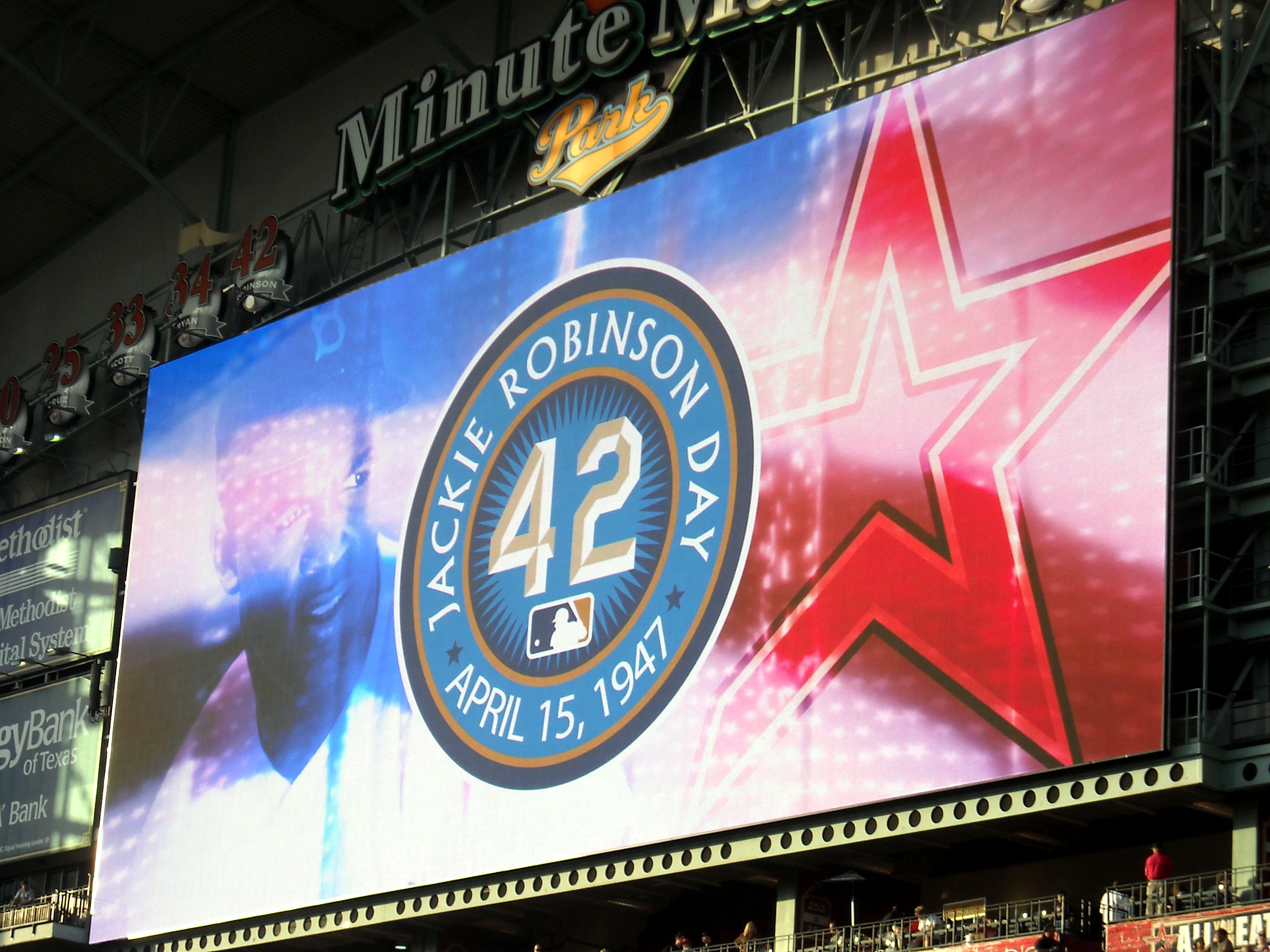
Jackie Robinson Day at Minute Maid Park.  Photo R. Anderson
Jackie Robinson Day at Minute Maid Park.
Photo R. Anderson

Look at the rosters of the 30 MLB teams today and one will find players from six continents.

None of that would have been possible without someone taking the first step to desegregate the diamond.

So it is fitting to take time to honor Jackie Robinson’s sacrifice and to ensure that generations who were not alive back in 1947 can learn the story and know that without the sacrifices of people like Jackie Robinson the world would be an entirely different place.

One of my favorite quotes is “Those who cannot remember the past are condemned to repeat it.” It was first stated in the early 20th century by George Santayana, but the phrase is still as true today as it was when first spoken. Society must continue to learn from history so as not to repeat the mistakes of the past.

Hunter Pence of the Houston Astros celebrates Jackie Robinson Day in 2011. Photo R. Anderson
Hunter Pence of the Houston Astros celebrates Jackie Robinson Day in 2011.
Photo R. Anderson

As another outlet to learn from the mistakes of the past this week also marks the release of the movie 42 which provides a big screen treatment of the momentous event and allows generations who were not alive in Jackie Robinson’s time to see what it was like.

As part of Jackie Robinson Day each player on every team wears the number 42 as a show of respect and solidarity. Of course one player still wears the number 42 every game but more on that in a bit.

While each team celebrated the moment in their own way the main celebration occurred in Los Angeles, CA where Jackie’s widow was in attendance at Dodger Stadium in Los Angeles.

During the annual celebration of Jackie Robinson there are always a select few who will state in various outlets that the inclusion of Jackie Robinson in the Baseball Hall of Fame was based solely on him being first to break the color barrier and is not reflective of his playing ability.

Of course, a quick look at his career statistics show that based on the merits of his play alone Jackie Robinson is every bit of a Hall of Fame caliber player and is included as much for what he did as a player as well as what he did as a trailblazer.

In 1997 all 30 MLB teams were told to retire the number 42 in honor of Jackie Robinson. Photo R. Anderson
In 1997 all 30 MLB teams were told to retire the number 42 in honor of Jackie Robinson.
Photo R. Anderson

In 1997 Major League Baseball retired the number 42 on all teams in honor of Jackie Robinson. As part of the retirement players who were still wearing the number were grandfathered in and allowed to keep wearing it for the remainder of their careers.

Currently Mariano Rivera of the New York Yankees is the only active player still wearing the number 42. Rivera is expected to retire at the end of this season so the number 42 will be officially retired 15 years after the announcement to retire it was made.

This means that starting in 2014, no player will ever again wear the number 42 in Major League Baseball. It is likely that the Yankees will retire Rivera’s number as well based on his impressive body of work. That will lead to the hanging of two 42 banners in Yankee Stadium with one for Robinson and one for Rivera. Then again the Yankees always did like to be a little different.

Of course this years celebration of Jackie Robinson Day was marred by the cowardly act of the Boston Marathon bomber.

At the time of the bombing only one MLB game had been completed with the Boston Red Sox and the visiting Tampa Bay Rays wrapping things up shortly before the first bomb was detonated.

The remaining MLB games Monday featured moments of silence for the victims of the attack. Acts like the bombing of innocent bystanders at the Boston Marathon show that the world is still as full of hate today as it was on that April day in 1947.

But just as was the case in 1947, there are still people willing to rise above the hatred and do what is right. And that is something worth remembering every day.

Now if you’ll excuse me, I am off to catch a screening of 42, perhaps I will see you there.

Copyright 2013 R Anderson

Southpaw Flashback: Orlando’s Historic Tinker Field Felled by Progress

Editor’s Note: For the remainder of June we will be counting down our 10 favorite columns as we celebrate summer vacation. Coming in at number 5 on our countdown is a column from May 6, 2015.

After receiving a one year stay of execution, the appeals process for a historic ballpark in Orlando, FL. ran out last week and the grandstands of Tinker Field began to crumble in the name of progress.

Think of almost any baseball player from the 20th Century and odds are pretty good that they stepped foot on the infield grass of Tinker Field at one time or another.

For several years one of the highlights of my birthday was seeing Cal Ripken, Jr. and the Baltimore Orioles play at Tinker Field. Photo R. Anderson
For several years one of the highlights of my birthday was seeing Cal Ripken, Jr. and the Baltimore Orioles play at Tinker Field.
Photo R. Anderson

From Spring Training for Major League Baseball, to full seasons of Minor League Baseball, the quaint little ballpark in the shadow of the Citrus Bowl was a unique venue where a who’s who of baseball players played from 1923 to 1999.

The last professional affiliated baseball at Tinker Field occurred in 1999 with the Orlando Rays who were the Double-A farm team for the Tampa Bay Rays.

While the Orlando Rays were the last of the Southern League teams to call Tinker Field home, they certainly weren’t the only ones.

The Orlando Twins, Orlando Cubs and Orlando Sun Rays were among the many teams to call Tinker Field home.

The Orlando Juice of the Senior Professional Baseball Association (SPBA) even spent a season playing on the hallowed field in the shadow of the Citrus Bowl.

This ticket stub allowed me entrance to Tinker Field where I ended up meeting one of my favorite baseball figures Earl Weaver outside the third base dugout. Photo R. Anderson
This ticket stub allowed me entrance to Tinker Field where I ended up meeting one of my favorite baseball figures Earl Weaver outside the third base dugout.
Photo R. Anderson

Eventually it was the shadowy neighbor looming over right field that signed Tinker Field’s death warrant.

While time and neglect certainly played a role in the demise of the nearly century old facility, it was a massive expansion of the Citrus Bowl that hastened the demise of Tinker Field.

The expansion of concourses crept into right field to the point that Tinker Field could no longer function as a professional baseball field due to an outfield depth that would make a Little Leaguer feel like Barry Bonds sending everything he hits over the fence.

Tinker Field becomes the third ballpark from my youth to be torn down joining Memorial Stadium in Baltimore and Baseball City Stadium in Haines City, Florida.  Photo R. Anderson
Tinker Field becomes the third ballpark from my youth to be torn down joining Memorial Stadium in Baltimore and Baseball City Stadium in Haines City, Florida.
Photo R. Anderson

So, despite being declared a national historic site, the demolition of Tinker Field is in full swing with the goal of removing every trace of grandstand, bleacher and dugout before a June Rolling Stones concert takes place at the Citrus Bowl.

Of course, while I can’t get no satisfaction in the fact that the stands where I spent summer nights of my youth will soon be reduced to dust, I can take some solace in the fact that the actual playing field will be saved as a small nod to the history that occurred there.

There is also some solace in the fact that many of the seats from Tinker Field were removed and will be sold to fans for use in their dens and Florida rooms.

Still despite saving some seats and the clay and grass part of Tinker Field, it will not really be Tinker Field anymore without the stands which once echoed with the sounds of the crack of the bats, cheering fans, and the Caribbean accented shouts of a peanut vendor who looked an awful lot like O.J. Simpson.

Tinker Field becomes the third ballpark from my youth to be torn down joining Memorial Stadium in Baltimore and Baseball City Stadium in Haines City, Florida. Of the three lost Ballparks the loss of Tinker Field hits the hardest as it is the one where I made the most baseball memories.

Tinker Field was where I first was able to see a live Spring Training baseball game on my birthday which is a tradition I still try to maintain each year.

Tinker Field was where I met and spoke with the late Earl Weaver on the third base line.

While I saw numerous Spring Training games at Tinker Field, it was Minor League Baseball that really grabbed my attention and stoked the desires of younger me to work in sports promotions at a ballpark. Photo R. Anderson
While I saw numerous Spring Training games at Tinker Field, it was Minor League Baseball that really grabbed my attention and stoked the desires of younger me to work in sports promotions at a ballpark.
Photo R. Anderson

Tinker Field was also where I saw the Clown Prince of Baseball himself, Max Patkin, perform his shtick on a sunny Florida day.

While I saw numerous Spring Training games at Tinker Field, it was Minor League Baseball that really grabbed my attention and stoked the desires of younger me to work in sports promotions at a ballpark.

During our trips to Tinker Field my mom and I were often joined for a few innings by team president, Pat Williams, who was also the General Manager of the Orlando Magic at the time, and I used to think how cool it would be to be a team executive getting paid to watch baseball.

I have yet to fully realize that dream of spending all of my summer nights as a Minor League Baseball employee but I may yet before all is said and done and when I do it will be because of those nights at Tinker Field.

I last visited Tinker Field in 1999 when the souvenir stand was offering clearance merchandise since the Rays were moving to a ballpark at Walt Disney World and it was easier to sell everything at a discount instead of moving it to the new facility.

I ended up getting an Orlando Rays fitted cap. To this day I am amazed that the employee correctly guessed my hat size just by looking at me. I am also amazed that in the years since my head has grown to the point where I can no longer comfortably wear the fitted wool cap.

I don’t know what happened to that vendor but I like to think he lived out his remaining years comfortably after his days at the ballpark were over randomly telling people on the street how big their heads were.

I last visited Tinker Field in 1999 when the souvenir stand was offering clearance merchandise since the Rays were moving to a ballpark at Walt Disney World.  I ended up getting an Orlando Rays fitted cap that I treasure to this day. Photo R. Anderson
I last visited Tinker Field in 1999 when the souvenir stand was offering clearance merchandise since the Rays were moving to a ballpark at Walt Disney World. I ended up getting an Orlando Rays fitted cap that I treasure to this day.
Photo R. Anderson

The Orlando Rays’ time at Walt Disney World was short lived and the team moved to Montgomery, Alabama and became known as the Biscuits.

To this day there are still no Minor League Baseball teams in Orlando making the decision to tear down Tinker Field an easier pill to swallow for some.

Others point to the peeling paint and overworked plumbing as reasons that it is best to raze the ballpark instead of spending money to preserve it and bring it up to current code.

In Houston people are dealing with a similar potential loss of a treasured sports fixture as the pending demolition of the Astrodome seems all but certain.

Recently fans were allowed inside the Astrodome as part of its 50th birthday celebration. The long term fate of the so called “eighth wonder of the world” is unknown. Like Tinker Field the Astrodome last hosted professional baseball in 1999.

With each year that passes it seems more and more likely that the Astrodome will also fall victim to a wrecking ball despite its historical significance.

The loss of the physical building, while difficult, does not take away the memories that occurred in those facilities.

Just as I am sure that there are people with fond memories of whichever Ballpark they grew up with, I can close my eyes and still picture Tinker Field the way I remember it right down to the tennis ball throwing peanut vendor, and the sounds of the rattling ceiling fans that tried their best to cool fans on those humid Florida nights.

I prefer to think of Tinker Field like it was, and not like the neglected facility it became.

The wheel of progress is always turning and sometimes it brings a bulldozer with it to raze the buildings of our youth.

Ticket stubs like this one from a Spring Training game at Baseball City Stadium, and memories are all that are left from the three Ballparks from my youth that have been torn down. Photo R. Anderson
Ticket stubs like this one from a Spring Training game at Baseball City Stadium, and memories, are all that are left from the three Ballparks from my youth that have been torn down.
Photo R. Anderson

I guess the morale of the story is to treasure your brick and mortar Ballparks while you can while building up memories that can last long after the Ballparks are gone.

Or as Simon and Garfunkel would say, “Preserve your memories, they’re all that’s left you.”

Now if you’ll excuse me, I have some Ballpark memories to preserve.

Copyright 2015 R. Anderson

Southpaw Flashback: Wallet Lost, Good People Found

Editor’s Note:  For the remainder of June we will be counting down our 10 favorite columns as we celebrate summer vacation. Coming in at number 6 on our countdown is a column from April 22, 2015.

The other day I did something that I have never done at a Ballpark, and hope to never do again.

That something was becoming separated from my wallet.

Through the years I have attended games at many Ballparks from Little League to Major League and every league in between.

At each of those games my wallet and I remained attached at the back pocket from the time I entered the Ballpark until the time I left.

Sure the wallet would come out from time to time to purchase concessions or souvenirs but after each transaction was completed the wallet would return to the security of Mr. Pocket despite the discomfort of sitting on a wallet on a hard plastic seat.

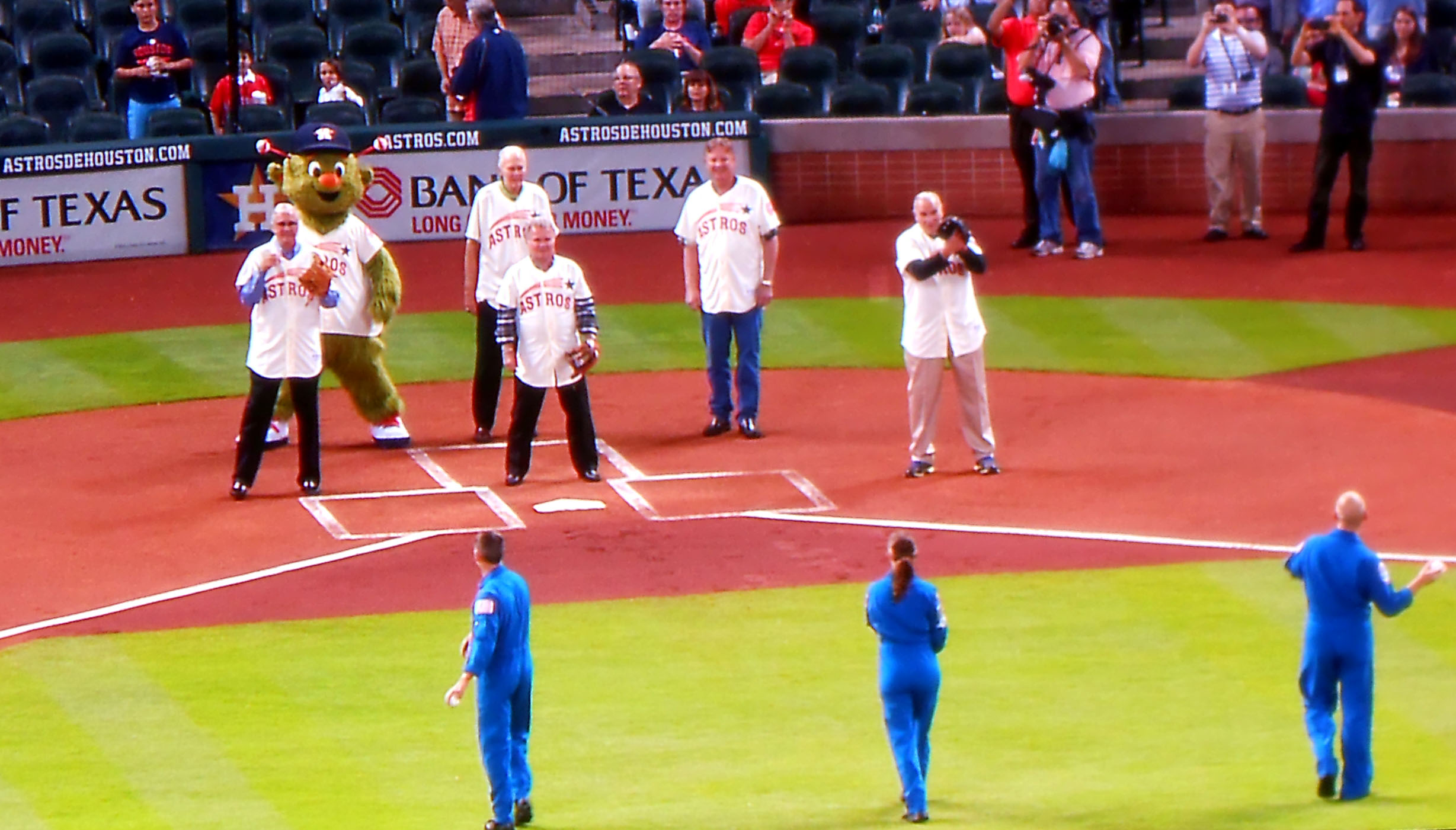
Saturday's Houston Astros game started with three astronauts throwing out ceremonial pitches and ended with a frantic search for a lost wallet. Photo R. Anderson
Saturday’s Houston Astros game started with three astronauts throwing out ceremonial pitches and ended with a frantic search for a lost wallet.
Photo R. Anderson

For some unknown reason during a recent visit to Minute Maid Park my wallet decided that it no longer wanted to be in my pocket and decided to venture out on its own.

I did not realize that my wallet had gone on a walkabout until I was standing on the lower concourse after leaving my seat on the upper concourse.

Upon first realizing that my wallet was no longer tucked safely inside my pocket, my first thought was that perhaps I had been the victim of a pick pocket since several people had bumped into me during my trek through the mass of humanity within the facility.

My next thought regarding my lost wallet was that perhaps I was not the victim of a pick pocket and instead it had fallen out somewhere along my journey between the highest point of the Ballpark and the lowest.

Shortly after watching George Springer cross home plate after a solo home run I was greeted by the sinking feeling of an empty back pocket where my wallet should have been. Photo R. Anderson
Shortly after watching George Springer cross home plate after a solo home run I was greeted by the sinking feeling of an empty back pocket where my wallet should have been.
Photo R. Anderson

I decided that the only course of action was to retrace my steps and hope that the needle that was my wallet could be located within the hay stack that was Minute Maid Park.

As I began my sprint back to the upper deck I allowed my thoughts to drift to the worst case scenario that at that very moment someone had my wallet and was up to no good.

While I was certainly not hoping for a worst case outcome, I knew that I needed to prepare myself in case that turned out to be what happened.

I knew that in this scenario whatever cash I had in the wallet was gone along with my driver’s license and credit cards.

There was nothing I could do about the lost cash, so I focused on the credit cards and who I would need to call to report the cards as stolen. While it would be a hassle to call them I knew that it was the only way to protect myself in the event the cards were stolen.

Ironically it was not the potential loss of cash, nor the loss of the credit cards that had me the most upset.

The view of the grounds crew raking the field was nice. Sprinting from the lower bowl to the upper deck in record time was not quite as nice. Photo R. Anderson
The view of the grounds crew raking the field was nice. Sprinting from the lower bowl to the upper deck in record time was not quite as nice.
Photo R. Anderson

The thought that troubled me the most as I ran up the three sets of escalators, was that I was going to have to go to the Department of Motor Vehicles to get a new driver’s license.

It is sad that the DMV was the place I most dreaded, but as anyone who has spent an afternoon waiting in line can attest it really is a fate worse than lost cash or credit cards.

Speaking of the escalators, as I approached the usher at the top of the last one he looked briefly like he was going to tell me not to run but I must have had a look of either shear motivation or madness that told him to step aside and let me through.

Clearly I was a man on a mission.

About a hundred or so paces from the escalator was the tunnel that led to the section where my seat had been.

After turning the corner and entering the tunnel I saw another usher holding something brown that looked surprisingly like my walkabout wallet.

As I got closer I could tell that the light at the end of the tunnel, or in this case the brown object in the usher’s hand, was in fact my wallet.

The view from the top where a kind stranger helped ensure a wallet lost would be a wallet found. Photo R. Anderson
The view from the top where a kind stranger helped ensure a wallet lost would be a wallet found.
Photo R. Anderson

Although I was out of breath from my multilevel sprint I managed to utter the words, “That is mine, thank you.”

Without a word in return the usher gave me my wallet and I turned around to head back to the lower concourse.

All of the worst case scenarios that I had feared, including that trip to the DMV, were no longer in danger of coming to pass.

My wallet, complete with cash, credit cards and driver’s license was once again safely in my pocket.

I still do not know how my wallet managed to extradite itself from my pocket, nor do I know exactly who found it and gave it to the usher.

What I do know is that someone in Section 410 of Minute Maid Park did the right thing and turned a situation that could have been very bad into something very good.

While I certainly don’t wish the stress of a sprint to find a lost wallet on anyone, sometimes it is those things that are needed in order to see the big picture.

Even though newspapers and television newscasts seem to be filled with only the stories of all of the bad things happening in the world, now and then it is important to be reminded that there are still good people in the world.

So to whoever found and returned my wallet last Saturday night I say, “thank you,” not only for the return of the wallet but for also showing a complete stranger an act of kindness and compassion.

Now if you’ll excuse me, I am off to buy some shorts with a Velcro closure on the back pocket to keep my wallet from further unapproved walkabouts.

Copyright 2015 R. Anderson

Southpaw Flashback: Some Ticket Stub Collectors are Buying Memories

Editor’s Note:  For the remainder of June we will be counting down our 10 favorite columns as we celebrate summer vacation. Coming in at number 7 on our countdown is a column from January 5, 2015.

Last week I mentioned that I wanted to dig up my ticket stub from the 1984 Citrus Bowl that I attended with my mother, grandmother and cousin.

I have pretty much every ticket stub from every sporting event I have ever attended, so I knew that if I dug deep enough I would most likely find it.

Sure enough in the wee hours of the morning Saturday I found the long lost ticket stub and a few others in a shoe box under my bed.

In 1984 endzone seats for the Florida Citrus Bowl went for $18. They have gotten much more expensive in the 30 years since. Photo R. Anderson
In 1984 end zone seats for the Florida Citrus Bowl went for $18. They have gotten much more expensive in the 30 years since.
Photo R. Anderson

As luck would have it, the shoe box was not the first place I looked for the ticket stub. I searched countless plastic totes in my quest to unearth the 30-year-old relic.

And while it took several days to find the ticket stub, and while I probably should have checked under the bed first, I did discover many other lost treasures which made the entire search quite successful.

Of course the main find, and the entire motivation for the search, was the 1984 Citrus Bowl ticket.

Some fun facts about that particular ticket stub is that an end zone seat at the1984 Citrus Bowl was only $18. I doubt that one could even get parking at a bowl game nowadays for $18 let alone a ticket to the game.

By comparison the cheapest ticket to attend the 2014 version of the Citrus Bowl was $45 and went up and up from there. Tickets for the National Championship game this year are averaging around $1700.

Economists will say that with inflation and other factors the $18 back then is comparable to today’s prices but something tells me it is still more expensive to attend a bowl game today than it was back then based on the epic growth that college football has gone through the past three decades.

While I was certainly pleased that I was able to find the ticket stub, thanks to the world of EBay and ticket stub collectors, I could have saved myself the trouble of digging through all of those plastic totes and just purchased a ticket from the game.

I never once considered the idea of purchasing a ticket online and quite frankly am surprised that there is a market for such things.

Each of the ticket stubs in my collection are attached to a memory of a game I attended as opposed to something I bought online. This particular ticket stub is from the game where I met Earl Weaver who I had looked up to for many years. Photo R. Anderson
Each of the ticket stubs in my collection are attached to a memory of a game I attended as opposed to something I bought online. This particular ticket stub is from the game where I met Earl Weaver who I had looked up to for many years.
Photo R. Anderson

As mentioned before there are three items that I try to get as a memento whenever I attend a game. Those items are a ticket stub, game program, and souvenir cup.

Each of these items are tangible extensions of my memories of attending the game and I collect them for my pleasure without worrying about what I can sell them for later.

Apparently though there is an entire industry based on selling programs, ticket stubs, and souvenir cups to anyone with an internet browser who is willing to pay the shipping and processing.

I get that if you lost a ticket stub for a game you attended as a youngster you may want to replace the item to help maintain a tangible piece to go with your memories of the game, but a larger segment appears to be buying ticket stubs for games that they did not attend.

Big sellers in the ticket stub business appear to be from marquee games.

Want to pretend you witnessed one of Nolan Ryan’s no hitters despite not even being born yet when the game took place? There is a ticket stub online for that.

A selection of Orlando Rays tickets are just some of the items in my collection. Photo R. Anderson
A selection of Orlando Rays tickets are just some of the items in my collection.
Photo R. Anderson

Want to add a Super Bowl ticket to your collection despite never setting foot in one? Click, click and it is yours.

Have you always wanted to pretend that you were there the night Kirk Gibson hit that big home run in the World Series? You know what to do.

Want to show your American pride by purchasing Olympic tickets from years gone by? You get the idea.

In this way people are purchasing other people’s memories since they did not go to the games that they are buying the ticket stubs from.

I suppose if someone wants to spend the money to own a ticket stub it is entirely their business, but in all of the years I have collected ticket stubs I have never once thought about trying to make a profit on them.

Every ticket stub in my collection is from a game that I physically attended. From professional football, baseball, hockey, basketball and various college sports, each ticket stub represents a seat that I occupied to witness that particular game with my own eyes.

Some of the ticket stubs are water logged reflecting that I battled through rain to see that particular game. Others are slightly bent from being stuffed in my pocket while I watched the game.

Each year for Spring Training I try to attend at least one Baltimore Orioles game. The tradition started in the mid 80's and has taken me to all sides of Florida. Photo R. Anderson
Each year for Spring Training I try to attend at least one Baltimore Orioles game. The tradition started in the mid 80’s and has taken me to all sides of Florida.
Photo R. Anderson

While I certainly do not need to own the ticket stub to prove that I was at the game, selling that ticket stub to someone else just seems like it would cheapen the experience and make me party to a fraud.

I certainly could be over thinking the whole buying and selling of ticket stubs, and may change my opinion at some future point, but for now the ticket stubs shall remain with their rightful owner.

Now if you’ll excuse me, I have a lot of plastic totes to stuff back into my closet.

Copyright 2015 R. Anderson

Covering the world of baseball one pitch at a time.