Hurricane Week Revisited Part 2: Reporting the Storm

Editor’s Note: Back in 2013, I ran a three-part series on what to do when a hurricane was approaching. Seven years later, with two named storms actively churning it seemed like a good time to look back, while also looking ahead, with the three phases of the storm. The three phases are before a storm arrives, the event horizon of storm arrival, and the aftermath following a storm’s departure. While this information is mostly geared to residents of coastal states in the path of storms, we encourage all of our readers to learn about the three phases of the storm. Today let us turn our attention to what happens once the storm arrives.

During a hurricane there are two types of residents, those who are riding the storm out in their homes, and those that went elsewhere during the brunt of the storm.

As a rule of thumb, I tend to ride out any storm lower than a Category 3. Storms larger than that and I will be one of the first ones pointing my car to dry land. There are of course exceptions to every rule and each storm needs to be considered on its own merits of risk.

For those who stay behind, the roads can be hauntingly quiet with the exception of emergency vehicles and others who have to be out on the roads. For the most part just prior to the arrival of the storm local authorities will urge residents to clear the roads and seek shelter.

Like moths to the flame news vans like this one on the Seawall in Galveston become a familiar sight before and after the arrival of a hurricane.
Photo R. Anderson

There is of course one group of out of towners that do not heed that warning; since it was the storm that brought them to town in the first place.

I am of course talking about the national reporters from Atlanta.

Okay, so the reporters come from elsewhere as well but with CNN and the Weather Channel based in the Peach State of Georgia it is a fitting statement.

For almost as long as there have been television reporters, residents of areas bracing for the storm have dealt with the arrival of reporters from various news outlets hoping to ride out the storm and win an Emmy in the process. This relationship of course can put revenue in the pockets of local hotels but for the most part it amounts to a lot of wind blowing much like the storm itself.

The reporter battling the elements cliché is one that is played out whenever nature strikes. Perhaps nowhere is this shown in its silliest sense than when a hurricane is involved.

Reporters dressed in their best outer wear try to convey that the storm is bringing pounding winds, waves and of course rain even if it isn’t.

To paraphrase Mark Twain in some instances, “the reports of the storm have been greatly exaggerated.

Since television is a visual media it does not do to simply report from the dry comfort of the hurricane command center about the conditions outside.

Oh no, the reporters from parts local and far and wide go out in the elements to share just how powerful the storm is.

The edge of hurricane Claudette arrives in Pensacola, Fl in 2003.
Photo R. Anderson

Of course, the reporters, while well-meaning, tend to turn it into a comedy bit when they do leave the safety of the hurricane command center. And I will admit to watching some of the continuing continuous coverage just to see the unintended comedy bits from the reporters.

To be clear, I am not wishing damage to anyone’s person or property during a storm it is just that some reporters go way overboard in trying to sell the story and quite frankly it makes for very compelling television for all the wrong reasons.

Common missteps including inability to hear the reporter, or losing that all important visual link, have all been experienced through the years by reporters covering from the heart of the storm.

There are even the reporters who get knocked down by the wind gusts but as one-hit wonder Chumbawamba would say they get back up again.

Then there are the reporters who try just a little too hard to sell the story. I forget which storm it was, but a few years back there was a reporter covering the terrible flooding conditions here in Houston. The reporter appeared to be up to their waist in floodwater and valiantly doing their live shot.

The only problem was when the camera operator panned back to show the scope of flooding a man could be seen a few feet away from the reporter in ankle deep water. So that can only mean one of two things. Either the reporter was sitting down in the puddle to make it appear worse than it was or the man behind her was a giant in search of his beanstalk.

Fe fi fo fum I smell an over reaching reporter, hmm.

Reporter embellishing aside, the swarm of reporters can serve a good purpose for the residents who were smart enough to leave the area ahead of the storm.

During Hurricane Ike, my parents were able to see their house on national television a day after landfall.

A news van from New Orleans waits for Hurricane Claudette to hit in Pensacola, FL in 2003.
Photo R. Anderson

Normally one would not want to see their house on television since reporters rarely are there just to say hello.

But in this case the sight of their home seemingly in one piece gave them peace in knowing that aside from some downed trees, chances were it was not as bad as they had feared it could have been.

Conversely, my house did not have a news crew drive by it so I had to wait until I got back home to see if it had survived the worst of the floodwater and the wind.

Another group aside from reporters that makes a beeline for the shore as the storm is hitting are of course the surfers. Big storms bring epic waves and when the waves are 10-12 feet above normal it makes for a temptation that is hard for some to resist.

Sadly, there are often deaths related to people underestimating the power of the waves in the storm. It is not uncommon to hear reports of people drowning or getting swept away by the waves while standing on a dock.

So, enjoy the waves from afar and enjoy the pratfalls of the out of town reporters from the dry comfort of one’s home. Hurricanes can be very powerful and they can be very deadly. It is crucial to keep that in mind and never tempt the belly of the storm.

Now if you’ll excuse me, all of this talk about waves has me curious to check tomorrow’s surf reports. Cowabunga dudes.

Copyright 2020 R. Anderson

Hurricane Week Revisited Part 1: Before the Storm

Editor’s Note: Back in 2013, I ran a three-part series on what to do when a hurricane was approaching. Seven years later, with two named storms actively churning it seemed like a good time to look back, while also looking ahead, with the three phases of the storm. The three phases are before a storm arrives, the event horizon of storm arrival, and the aftermath following a storm’s departure. While this information is mostly geared to residents of coastal states in the path of storms, we encourage all of our readers to learn about the three phases of the storm. Regular baseball themed content will return next week but for now, let us focus on a message of public safety. Today let us turn our attention to what to do before the storm arrives.

As I have mentioned before I would much rather face a hurricane than a tornado any day of the week.

That is not to say that I want to experience either. But given the choice of the two, hurricanes are preferred in that they allow more time to prepare people and property prior to their arrival.

For the most part residents in the path of a storm will know days in advance of the likelihood of their being impacted by the storm through computer modeling and tracking.

It should be noted that the tracking models from various agencies around the world do not always agree on the path of the storm which leads to models showing a variety of impact zones.

The time to prepare for a hurricane is long before the first rain bands hit.
Photo R. Anderson

These impact zones are than tabulated to create a cone of uncertainty where the center of the storm is most likely to arrive. Of course, depending on the size of the storm, impacts can be felt for hundreds of miles away from that landfall area where the eye touches dry land first.

Once a storm is predicted to hit a certain region, the residents spring to action and buy up all of the water and other supplies that they can get their hands on.

Of course, one does not need to wait until a storm is barreling towards them to get their supplies. In fact, it is best to get the Hurricane kits made early in the season so that in the event that a storm if approaching time can be used for securing property and planning an evacuation from the path of the storm as needed.

So, what should a good hurricane kit include?

While each kit can be tailored to the person making it, a general list of items to include in a hurricane kit includes a first aid kit, water, supplies, documents, clothing, and of course food. The general rule is that the kit should allow enough supplies to last three days.

Let’s look a little more into each of the areas, shall we?

The American Red Cross recommends a first aid kit for both home and car ahead of the arrival of a hurricane.
Photo R. Anderson

First Aid Kit: A first aid kit for both car and home is a good rule of thumb. The kits should include prescriptions, band-aids, antibiotic ointment, alcohol wipes, bandages, gauze, tape, pain relievers, antihistamines, latex gloves, safety pins, tweezers, aspirin, antacids, a towel, Calamine lotion for insect bites, insect repellent, tissues, and sunscreen. As water is a major component of Hurricanes the kits should be placed in water proof containers to protect them.

Water: The American Red Cross and other agencies recommended having one gallon of water per person per day. Half of the water is used for drinking with the rest being available for hygiene.

Supplies and Tools: A fully charged cell phone and flashlight will be useful in the event of electricity going out. Having a car charger for the cell phone is also worth packing. A battery powered radio with plenty of spare batteries is also a good thing to have in order to hear updates and instructions that may come across the airwaves.

Plenty of flashlights and batteries can shed light on dark days after a storm knocks out power.
Photo R. Anderson

Do not assume that there will be power and cable service. It is best to hope for the best but prepare for the worst.

Plastic utensils, paper plates, plastic bags and napkins and antibacterial wipes are also important.

Documents: Passports, birth and marriage certificates, social security cards, deeds, insurance papers, wills, and other important paper work should be placed in water proof containers as well, in order to be ready to grab quickly in the event of an evacuation.

Clothing: Assuming one might not be able to bathe for a few days, a change of clothes can be very important to help feel less overwhelmed. In addition to the normal items one might wear, since rain will likely be a factor, it is good to also pack waterproof outer clothing and boots to avoid that soaked to the bone feeling.

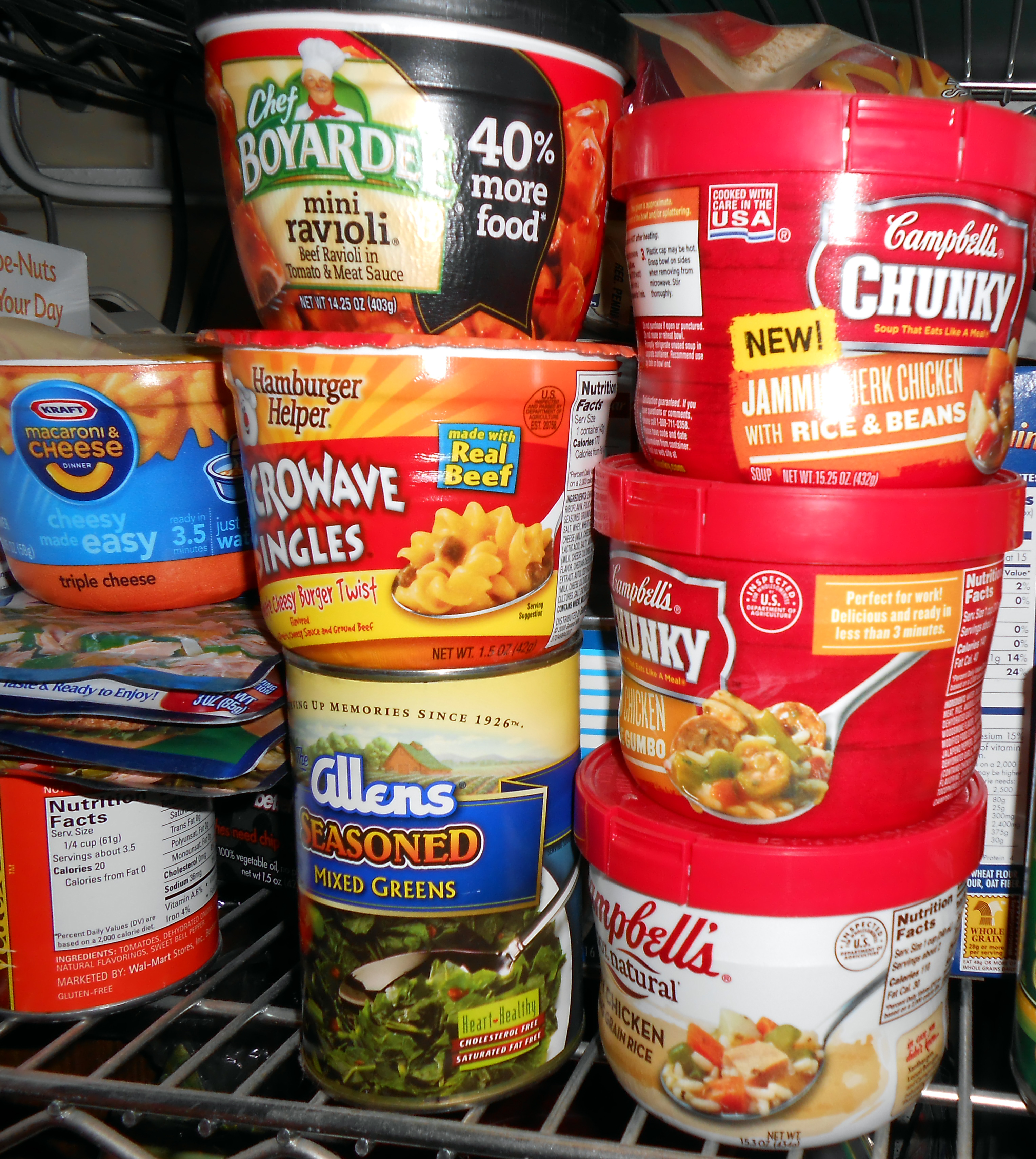
Non perishable food like the items pictured are crucial to have after a hurricane hits.
Photo R. Anderson

Food: Be sure to stock up on non-perishable foods. Some of the best items to consider are energy/protein bars, crackers, peanut butter, nuts, canned fruit and vegetables, canned tuna/chicken, cereal, dried fruit, and even baby food.

And of course, even though many cans offer a convenient pop top opening don’t forget a manual can opener.

This is of course in no means a complete list of items to grab before the storm but it is certainly a good starting point for anyone in the path of a storm to keep in mind.

I have ridden out storms where the electricity didn’t flicker once and I have had storms where I lost power so no storm is exactly alike and all regions are not affected the same way. I do know that when the power is out it is definitely not the time to go try to find batteries at the store.

Proper preparation prior to the storm definitely makes riding out the storm more comfortable. At least as comfortable as it can be.

Now if you’ll excuse me all of this talk about canned goods has me tasting some canned ravioli. I just hope I remember to save some cans for the supply kit.

Copyright 2020 R. Anderson

Dr Pepper Shortage Shows 2020 Loves to Give Until it Hurts Before Giving a Little More

If the year 2020 were a gift, it would be the type of gift that was so hideous that you wouldn’t even regift it to your worst enemy.

From COVID-19 running wild across the globe like a herd of Chincoteague ponies, to toilet paper shortages, disinfectant wipe shortages, distance learning for all, social distancing, sports played in bubbles, as well as sports played outside of bubbles; 2020 has had a little of everything.

We also cannot forget the invasion of murder hornets, attacks on the United States Postal Service, masks becoming a political statement, and oh yeah, the potential of two hurricanes churning in the Gulf of Mexico at the same time for the first time since the Great Depression.

For years, the late Hugh Downs and Barbara Walters told viewers every Friday night that, “This is 20/20.” Maybe they were trying to warn us that 2020 would be something that would be studied with the hindsight of 20/20 vision once it is over.

The band Green Day famously sang, “Wake me up when September ends.” We have not even gotten to September yet, and many people are likely singing wake me up when 2020 ends.

As a side note, I was supposed to see Green Day, Weezer and Fall Out Boy earlier this month. But thanks to COVID-19, that concert, like so many other things this year was cancelled.

On top of all of the other things that have made 2020 the type of year one would like to be done with; we can now add a Dr Pepper shortage to the list of things that could only happen in 2020. Take away my toilet paper, fine. But take away my Dr Pepper and I will likely have serious withdrawal symptoms.
Photo R. Anderson

On top of all of the other things that have made 2020 the type of year one would like to be done with, we can now add a Dr Pepper shortage to the list of things that could only happen in 2020.

Take away my toilet paper, fine. But take away my Dr Pepper and I will likely have serious withdrawal symptoms.

To be clear, I choose Dr Pepper over toilet paper because, one can always find alternatives to use when the toilet paper runs out, but there is only one Dr Pepper. I have tried all of the store brand colas that claim to be just as good as Dr Pepper, but none has come close to replicating that perfect blend of 23 flavors.

A few years ago, I even tried making my own Dr Pepper in an experiment that can be called a disaster at best.

So how much do I love Dr Pepper? Let me count the ways.

I have tried Dr Pepper in milkshake form.

So how much do I love Dr Pepper? Let me count the ways.
Photo R. Anderson

I have tried Dr Pepper flavored Jelly Beans.

I have tried Dr Pepper flavored baked beans.

I have tried Dr Pepper flavored barbecue sauce.

I have been known to wear Dr Pepper clothing.

I have classic glass Dr Pepper bottles as my kitchen backsplash.

When I want an extra authentic feel, I drink my Dr Pepper out of an antique Dr Pepper glass.

Lastly, three years ago I dressed up as Larry Culpepper, the fictional Dr Pepper stadium worker, made famous through a series of ads shown during college football games.

So, it is fair to say that when it comes to Dr Pepper, I celebrate the entire catalog.

That is not to say that the only thing I drink is Dr Pepper. Iced tea and Dr Pepper are my go-to get the day started beverages, as well as my keep the day going refreshments.

I also drink about a gallon of water a day as well, so I do not want it to sound like I have Dr Pepper and iced tea running through my veins with an IV drip. I tried that, but my doctor said that my insurance didn’t cover it.

Despite the lack of an IV drip, go-go juice and punga punga juice, as younger me called Dr Pepper and iced tea, respectively, are never far from my grasp.

That was until 2020 when the Dr Pepper supply dried up faster than a lake bed in the desert and I suddenly found my grasp on securing the sweet nectar slipping.

According to a tweet from the powers that be at Dr Pepper, the shortage is due in part to higher than anticipated product demand in the form of cans and bottles. As noted a few weeks ago, one of the other gifts COVID-19 gave us was a shortage of aluminum cans.
Photo R. Anderson

According to a tweet from the powers that be at Dr Pepper, the shortage is due in part to higher than anticipated product demand in the form of cans and bottles.

As noted a few weeks ago, one of the other gifts COVID-19 gave us was a shortage of aluminum cans.

It is unclear what role, if any, the can shortage is having on the supply of Dr Pepper, since it is sold out in bottle form as well.

While I am sure that Dr Pepper will return to shelves in the not too distant future, the current disruption in the availability in stores, is yet another reminder of how fragile our supply chains are.

That is not to say that there are not hard-working men and women involved in the logistics business. But it does suggest that with supply chains spread out across the globe just one ripple can cause huge waves down the line.

I still shake my head at the fact that one of the key ingredients in disinfectant wipes manufactured in Wuhan, China, ground zero for COVID-19; leading to a scenario where certain cleaning products are expected to be in short supply until next year.

I know that companies move production overseas to keep costs down and to maximize profit, however, I think there will be a lot more legs of supply chain chicken coming back home to roost.

Of course, we need to contain the wildfires both real, and biological, that are raging within our shores before any roosting can happen.

Dr Pepper was born in Texas, so of course there is a Texas barbecue joint in the state capital that makes a Dr Pepper infused sauce. Barbecue and Dr Pepper is second only to a Ballpark view and a Dr Pepper. Of course, eating barbecue sauce and barbecue beans infused with Dr Pepper, at Dr Pepper Ballpark while drinking a Dr Pepper would be the Holy Grail of demonstrating that one was a Pepper.

At the end of the day, not being able to buy Dr Pepper really is as they say, “a first world problem.” Containing a global virus named COVID-19 in the world’s richest nation should not be as hard as people are making it out to be.

As a first world nation, America’s COVID-19 response should have led to a first world solution.

Instead, the United States’ COVID-19 response turned into a doctoral course in how not to run a pandemic response that was run by a man whose university was shut down.

Finding a solution to COVID-19 used to be the type of problem Americans would unite to defeat.

Then again, in the current climate where half of Americans are Coke, and the other half are Pepsi, it really shouldn’t be a surprise that six months into the pandemic there is still no national strategy to combat it.

At least the cola wars didn’t kill anybody. Contrast that to the over 170,000 Americans who have died from COVID-19 while some leaders stick their head in the sand, or worse try to distract with conspiracy theories, and blaming the people who live rent free in their head.

So instead of getting a handle on the virus, the virus is handling us like a coast to coast game of Whac-A-Mole.

One of my favorite Ballpark beverages is Dr Pepper. One of my favorite Minor League Ballparks is Dr Pepper Ballpark in Frisco, TX. Put them together, and it means an ice-cold Dr Pepper is always available with a side of baseball.
Photo R. Anderson

Before the world was shut down for COVID-19, I had planned to visit Dr Pepper Ballpark in Frisco, TX home of the Frisco Rough Riders for the first time in years to score a Ballpark triple play of Dr Pepper, Hot Dog, and ball game. Hopefully, I can do that next year.

Of course, my trip to Frisco, TX, like many other things, is on hold until COIVD-19 is defeated. So far, COVID-19 is hitting most of the pitches thrown at it into the empty grandstands.

Now if you’ll excuse me, I am off to slowly sip one of my rationed cans of Dr Pepper while looking at spaghetti models of the two tropical systems heading my way. Is it 2021 yet?

Copyright 2020 R. Anderson

Way back Wednesday: Remembering the Lost Art of the Postcard

Editor’s Note: I wrote this column on the lost art of sending postcards back in March 2013. During the current climate of COVID-19, as well as the attempt by some to disrupt the United States Postal Service’s mission to ensure that, “Neither snow nor rain nor heat nor gloom of night stays these couriers from the swift completion of their appointed rounds,” it seems appropriate to reflect on the connection people can feel through the mail.

It is also important to remember the old AT&T telephone jingle to “Reach out, reach out and touch someone,” during this time of COVID-19 to let people know you are thinking about them.

Of course, in the current COVID-19 climate, any reaching out should be done from a safe social distance. In the meantime, please enjoy this column as part of our occasional Way Back Wednesday feature.

In this age of instant messaging, e-mail, Twitter, and other ways to communicate at the speed of light, it may come as a shock to some of the younger readers that there was once a time when correspondence was not handled as quickly.

Before the days of Facebook, it was not possible to post a status while on vacation to all of your friends to let them know that you were “Having a great time exploring the world’s largest ball of twine.”

Instead, when you were at that ball of twine, and you wanted to let your friends know how much fun it was before seeing them again in person, you had to buy a postcard and actually place it in something called a mailbox. Your friends would than receive the postcard, and your thoughts on the ball of twine in a few days.

Yes, I know mailboxes still exist, and based on what comes in mine they tend to be a conduit for junk mail and bills alone.

As such I now only check my mail a couple times a month; since there really isn’t anything worth reading that would require me to check it any more frequently.

Once upon a time mailboxes served as a window to communicate with the world. Today, mine mostly serves as a place for junk mail and bills.
Photo R. Anderson

I have made a career out of writing. I was able to made the transition from writing for print publications, to writing for electronic platforms.

For the most part, writing is writing. There will always be a need for clear content to be communicated regardless of the changing platforms as technology moves forward.

While I know that the ways people communicate has changed, sometimes I find myself feeling a bit of nostalgia for the written word and the simple act of receiving a post card through the mail.

Part of this nostalgia was the result of looking through my postcard collection the other day to help remember the name of somewhere that I went on vacation many years ago.

I ended up finding that postcard and my memory was jogged. Looking through the box, other memories were set free as well.

Many of the postcards in my collection were sent to other family members before I was born and were just passed down to me; but several are actually addressed to me. One particular series of cards was the result of a chance encounter on an airplane.

When I was in third grade, my mom and I were on a flight from Washington D.C. to Orlando, FL. There was an older gentleman in the row with us (of course when I was that age everyone was older, so my memory of how old he really was may be warped).

As it was a relatively long flight, we ended up making conversation. Over the course of the conversation, he mentioned that he did a lot of traveling as part of his work with the Army.

I do not recall the whole scenario of how it occurred, but addresses were exchanged and he mentioned that he would write me from his travels.

The postcards did not always include a message but this is typical of the type of message when they did.

In this more jaded world that we find ourselves in now, the chances of a stranger getting the address of a young child under the guise of sending correspondence would probably be less likely to occur.

I for one have become way more suspicious of people’s intentions the older I get.

While it is certainly good to be skeptical, and careful of one’s surroundings, and those that enter them, I sometimes wish that I could see the world through younger me’s eyes when the world was a far less scary place. Back then, the only things I needed to worry about were which pair of pajamas to wear, and how many days until I could ride my bike to the 7-Eleven to check out the latest comic books, or buy a pack of baseball cards.

A few weeks after returning home, I got my first postcard from the man on the plane. The postcards continued for several years, and always included a short note about the destination included on the front.

One of the postcards my pen pal from the plane sent me.

The cards stopped one day, which could have been the result of many factors including the forwarding address feature no longer working, or perhaps the man behind them was no longer able to send the cards for whatever reason.

While I do not remember his name, I do remember the simple act of sharing postcards with a wide-eyed child and the effect that had and continues to have. I have no way of knowing if that man on the plane is even still with us.

If he is, I hope that he is well and is still able to take those wonderful trips that sparked my imagination so many years ago.

But those postcards, as well as the others I received from friends and family, helped me see parts of the world that were harder to see in the pre-internet days and certainly helped nurture my love of traveling.

Some 30 years later I still fondly recall the postcards from my pen pal. Tweets and e-mails will not hold up as well through the decades I imagine.

Today, thanks to the internet, if I want to see a picture of something I need only type it into a search bar and before long I will have more pictures to look at than I could ever hope for.

The Internet has opened the world up to us but in some ways it has also made us more alone than ever before.

I often think about other chance encounters and people who come into our lives for a brief moment and the impact that they have on us. Had my mom and I been seated in any other row on that airplane, I would not have received the postcards.

When I was in Journalism School, one semester my professor assigned the class a project to go to the food court at the mall and observe people. The point behind the assignment was to make note of the various interactions of people coming and going in order to imagine various scenarios as to what brought them there. To this day, I still enjoy people watching.

The next week, the same professor assigned us to go back to the same food court and find a stranger to interview. The point of the exercise being that everyone of us has a story to tell. The trick is to know the right questions to ask to get the ball rolling.

While the memory of the man on the plane will probably not make me any less cautious than I am, since the world today is so much different than it was all those decades ago it is still a nice memory and shows that we all do have stories to tell. The key is to just be open to hear them.

Now if you’ll excuse me, I think I am going to find a food court and see if my interview skills are still as sharp as they once were.

Copyright 2020 R Anderson

Summer Hockey is a Small Silver Lining in an Upside Down Sports Year

If anything can be said of the 2020 sports landscape, let it be said that 2020 has been a season like no other.

From fan-free stadiums and Ballparks, to playing sports in a bubble, sports fans are truly seeing things they likely never thought they would see. Of course, due to social distancing they are seeing it from a safe distance which most likely means from their couch.

One of the biggest treats I have discovered during this upside-down season is summer bubble hockey.

Normally I would be fully engaged in the Major League Baseball (MLB) season this time of year. However, thanks to COVID-19 taking a sledge hammer to the schedules of the major sports leagues, the National Hockey League (NHL) is fully engaged in the quest to crown a team worthy of hoisting Lord Stanley’s Cup meaning the “Boys of Winter” are now the “Boys of Summer,” at least for this season.

Washington Capitals Captain Alex Ovechkin is seeking his second Stanley Cup Finals victory. Unlike previous years, thanks to COVID-19 The Capitals and the rest of the Stanley Cup eligible teams are playing hockey during the summer while quarantined in either Toronto, or Edmonton.
Photo R. Anderson

To say that I am enjoying summer hockey would be the same type of understatement as saying that I enjoy breathing.

While breathing is a mostly automatic factor that I take for granted, I had no idea how much breath I would get out of four hockey games a day.

With teams safely quarantined in either Toronto, Ontario or Edmonton, Alberta, there are literally back to back to back to back hockey games on almost every day.

That is like a hat trick of hockey plus an overtime period. Or stated in a more Canadian way, it would be like ordering poutine and learning that the chef made too much, and, instead of throwing away the extra he is giving it to you at no extra cost.

The Vancouver Canucks have given their mascot, Fin, something to cheer about; albeit from a social distance and outside of the Edmonton bubble. The Canucks have a two games to one lead over the defending Stanley Cup Champion St. Louis Blues
Photo R. Anderson

It should be said that I am totally sorry that it took a global pandemic to create summer hockey. COVID-19 is a horrible disease that I am ashamed to say the United States government has not done enough about.

Over 170,000 Americans have died from COVID-19 at the time of this writing. That is unacceptable. Each and every one of us should be holding our elected officials accountable for the way it was mismanaged.

Also, the rush to reopen schools, with zero coordinated effort, is already generating the type of results that anyone paying attention to the way germs spread could have told you would happen.

A week after returning to on campus classes, the University of North Carolina is shutting down in person learning and going back to online instruction due to outbreaks of COVID-19. Of course, UNC was quick to point out that even with students learning remotely have no fear the Tar Heels are still on track to play football in the fall, and travel from city to city with the Atlantic Coast Conference (ACC).

Unfortunately, instead of focusing on the important things, the bulk of the country has seemed to embrace a “let them eat cake” philosophy. Although instead of cake as the tone-deaf refrain, it is let them play football.

Playing hockey in two arenas where players are quarantined, is a completely different matter than allowing college football teams to go from town to town to bring people enjoyment on the weekend.

MLB has shown that playing outside of a bubble and traveling is a perfect recipe for catching and spreading COVID-19.

Stand up if you had summer Zamboni rides on your 2020 Bingo Card. Thanks to COVID-19 a winter sport is now a summer sport as the NHL seeks to crown a Stanley Cup Champion from inside the bubble.
Photo R. Anderson

Of course, the proponents of playing college football are likely to say that there is way less physical contact in football than there is in baseball. So the ability for the virus to spread won’t be as high, oh wait…

As I have said many times, I love college football. I would love to be watching college football when September rolls around. However, we are not in a position where that would be wise to do.

I also don’t see us magically getting the case count of COVID-19 to a low enough level in the next four weeks where playing college football is a wise thing to do.

Dr. Deborah Birx, the head of the White House Coronavirus Task Force, said that she wished that the United States had shut down and managed the virus in the same way that Italy did. Perhaps if the task force she is in charge of had made a stronger case for that, people would have listened.

Instead, America did a halfhearted shutdown before opening things wide open in time for Memorial Day. I mean why let a global pandemic get in the way of a three-day weekend, right?

As anyone who pays attention to how trends work could tell you, the levels of COVID-19 went up faster than a high stick in a hockey rink; and all of the gains made during the brief shutdown were lost.

Instead of a unified approach to the virus, some Americans wore masks and socially distanced, while others called the virus a hoax and said wearing a mask infringed on their civil liberties. Seriously?

When did doing what is right for the greater good become a political statement?

It looks like COVID-19 will continue to rage until there is a vaccine since some people cannot bring themselves to wear a mask. As a result, I will continue to enjoy bubble hockey from the safety of the Gigaplex.

I would love to be back out in the world doing the things I did before March of 2020. However, with around 1 in 4 people around here infected with COVID-19, and with so many unknowns about the long-term impacts of the disease, I am choosing to stay safe by limiting the number of things I do outside the Gigaplex. And when I do venture forth, I wear a mask and keep a safe social distance from those around me.

In Texas, very few people seem to be wearing masks. I guess they are still thinking they are immune. Either that, or they enjoy playing an extended game of Russian roulette. After all, I believe one of the conspiracy theories being spread on the misinformation superhighway is that wearing a mask takes away your Second Amendment rights.

That would be so worthy of a face palm, although as part of being COVID-19 aware we are not supposed to touch our faces. So, a virtual face palm will have to do.

The next NHL season is supposed to begin in October. Whether that season begins in two bubbles in Canada pretty much rests on what we do over the next two months to take COVID-19 seriously.

As much as I love bubble hockey in the summer, I really would like to attend sporting events in person again.

I am wearing a mask and doing my part to make that happen. What about you?

Now if you’ll excuse me, my Kraft Dinner is waiting.

Copyright 2020 R. Anderson

Covering the world of baseball one pitch at a time.