Category Archives: Major League Baseball

A Topps Quest 30 Years in the Making

Through the years, I have collected everything from Matchbox Cars to books from the late 19th to early 20th centuries.

It has been said that my collections have collections.

Among all of my collections and interests, one of the earliest things I collected were baseball cards.

Back when packs of baseball cards could still be purchased for pocket change and included a stick of card staining bubble gum, I collected cards with the best of them.

I even had a small business selling cards to my friends and neighbors and would buy boxes of cards at the Sam’s Club. I would also ride my Diamondback bike to the neighborhood 7-11 and get a few packs of cards, some comic books and some powdered doughnuts.

Of course, I would not look at the cards and comic books while eating the powdered doughnuts. No one wants to get powdered sugar on their cards and comic books.

From 1983 to the mid-nineties, I collected cards with a vengeance. My collection was not limited to baseball cards.  Football, hockey and NASCAR cards were also collected. I even have some cards from various televisions shows and movies.

This album was started 30 years ago. This is the year it is finally completed. Photo R. Anderson
This album was started 30 years ago. This is the year it is finally completed.
Photo R. Anderson

Put quite frankly, my collection of cards had a collection of cards.

A goal each year was to compile a complete set of cards.

Many of the sets were put together pack by pack, which meant many doubles, triples, and even fourths of cards were inevitable.

In some cases, the extra cards could be traded for missing cards needed to complete the collection. In most cases though, the extras went into boxes in a closet to be forgotten about.

While I always preferred the traditonal method of completing a set one pack at a time, some times sets joined the collection as part of factory sealed sets which allowed me to finish the set with a single purchase. Factory sets also ensured that the dreaded gum stained cards would not be an issue.

The other day, it was announced that Ryne Sandberg had been named manager of the Philadelphia Phillies. That announcement got me thinking about baseball cards again.

So, what does Ryne Sandberg’s promotion have to do with baseball cards? I am glad you asked.

It has to do with baseball cards in that the promotion of Ryne Sandberg got me thinking about my 1983 Topps baseball set; which included Ryne Sandberg’s rookie card. The 1983 Topps set also included the rookie cards of Hall of Famers Wade Boggs and Tony Gwynn.

Recently named Phillies manager Ryne Sandberg was a rookie with the Cubs in 1983. Photo R. Anderson
Recently named Phillies manager Ryne Sandberg was a rookie with the Cubs in 1983.
Photo R. Anderson

As I was thumbing through my 1983 set, I was reminded that while it was the first year that I started collecting baseball cards. It also represented my only unfinished set in my collection.

So, 30 years after I first started the set, I decided while sitting on my living room floor that I would finished the set before Christmas this year.

It would have been much easier to have had this grand vision back in January to have eight more months in which to work on the goal. However, I have always worked better under the pressure of deadlines. So, over the next four months I will complete the set.

Finding assorted 30-year old baseball cards will not be easy. While there are a few shops that may still have a dusty binder full of cards, it is more likely that I will end up using the internet to find the missing pieces of cardboard.

Back when I was collecting my sets before, I carried around checklists in my wallet for each set I was working on. The checklist was numbered from 1 to 792, or how ever many cards that particular set had and has I found a card I would cross it off of the list.

The checklists came in quite handy whenever I was trading cards with friends or looking through boxes of cards at a baseball card shop. With a single glance I could tell which cards I had and which ones I needed.

After creating a new list it was determined I am around 100 cards short of completing the 1983 Topps set. Photo R. Anderson
After creating a new list it was determined that I am 125 cards short of completing the 1983 Topps set.
Photo R. Anderson

Sadly, I could not locate my 1983 checklist when I went looking for it. So, the first step in resuming the quest to finish the set was to determine how many cards I still needed by creating a new checklist.

One by one, I went through my binder with the 1983 set in it and crossed of the corresponding number on the checklist. I was encouraged as each number was crossed off since it meant that it was one less card that I needed to find.

After a very detailed review, it was determined that I still need 125 of the 792 cards in the set to complete my 30-year quest. While the number is larger than I had hoped, it is certainly doable to complete.

A quick search online showed that I could order the complete 1983 set for around $50 if push comes to shove. However, I think I will try the old fashioned one card at a time route just like 30-years ago me would have done.

This time I will have Ebay at my disposal. So, I will only have to worry about getting the powdered doughnut stains on the keyboard instead of the cards.

Now if you’ll excuse me, I need to try to figure out where to find some 30 year-old baseball cards.

Copyright 2013 R. Anderson

Upon Further Review, Replay Coming to Baseball

Baseball is often a game that is slow to embrace change.

This can at times be both charming, as it harkens to a simpler time, as well as being frustrating to some when the old ways can shift the outcomes of games through blown calls that seem obvious to everyone other than the umpires making the calls.

This is not to say that umpires are to be blamed for all blown calls. They are often times having to make a split second decision between safe and out without the benefit of the high definition slow motion angles that the viewers at home have.

Managers and umpires have had a love/hate relationship for years. Some of the strain in the relationship comes from blown calls by the umpires. Starting next year managers can challenge three of those calls a game as part of an expanded instant replay. Photo R. Anderson
Managers and umpires have had a love/hate relationship for years. Some of the strain in the relationship comes from blown calls by the umpires. Starting next year managers can challenge three of those calls a game as part of an expanded instant replay.
Photo R. Anderson

That is also why a close call is never replayed in the ballpark. This is done to avoid further inciting fans who feel that a call was not made the way it should be.

Many sports already use replay to help with questionable calls. The NFL has replay on all scoring plays in addition to coach’s challenges on non-scoring plays.

A few years back Major League Baseball dipped their toes into the replay pool by allowing replay on whether certain balls that bounced back into the playing field were home runs.

When it was announced that home runs were now able to be reviewed there were those that were happy and felt that baseball was finally catching up with the times and others who thought that an already long game would get even longer through the inclusion of replay where the umpiring crew left the field to view a television monitor.

Both of those sides of the argument were given something else to cheer and/or jeer Thursday when it was announced that Major League Baseball will implement instant replay on virtually every play but the strike zone starting next season. And much like the NFL manager’s will be allowed up to three challenges per game.

While announcing the change Major League Baseball Commissioner Bud Selig called the announcement “a historic day” for baseball.

Whether a pitch is thrown for a ball or a strike will still be the umpire's call despite expanded replay rules coming to Major League Baseball. Photo R. Anderson
Whether a pitch is thrown for a ball or a strike will still be the umpire’s call despite expanded replay rules coming to Major League Baseball.
Photo R. Anderson

While still giving the home plate umpire the final word on balls and strikes, mangers will be able to challenge up to three calls during a game.

The challenges will be broken down with one available during the first six innings, and two beginning in the seventh inning. There will be no additional challenges given for extra-inning games.

After a manager has used his allotment of challenges, an umpire crew can make a review of its own only to determine home-run calls.

The ruling on a challenge will be determined by umpires stationed in a central command center in New York and will not be determined by the on-field umpiring crew.

Time will tell whether the roll out of the type of instant replay that certain fans have wanted will improve the quality of the game or will just add another delay tactic for managers to use.

Time will tell whether the new power to challenge calls improves or strains the umpire/manager dynamic. Photo R. Anderson
Time will tell whether the new power to challenge calls improves or strains the umpire/manager dynamic.
Photo R. Anderson

There have certainly been some high profile examples of umpires making calls that have altered the outcome of a game. There was a blown call on a perfect game attempt a few years back as well as some other examples where human error led to a different outcome.

Personally I have always felt that an equal number of bad calls go against each team so that in the end they all sort of even out. But, I can certainly see where replay could be beneficial to help ensure the quality of the game and to avoid post-game press conference by umpires who after further review admit they should have made a different call.

While the reply roll out should help clear up game altering calls, I would much rather see a system that implemented a universal strike zone across all 30 Ballparks than a system that looked at whether a runner beat a tag at second base or not.

Pitch tracking software for years has shown subtle differences in how umpires call balls and strikes despite a defined strike zone in the rule book.

Much like the batters each manager will be given three challenges, or strikes a game. Once the challenges are gone a manager has no more recourse to dispute a blown call. Photo R. Anderson
Much like the batters each manager will be given three challenges, or strikes a game. Once the challenges are gone a manager has no more recourse to dispute a blown call.
Photo R. Anderson

It seems that maintaining control at the plate was one victory that the umpires were able to hang on to as it has been a point of debate for many years now. It just seems like Major League Baseball would want to enforce the same strike zone since getting called out on a ball that was called a strike seems to happen far more than a questionable tag out.

I remain hopeful that the next major change in replay rules includes the universal strike zone. Until then I guess we will just have to see how the managers manage their challenges and whether they will be given a red challenge flag to throw on the field like their NFL counterparts or will just run out of the dugout when they want a challenge.

Either way starting next year the game of baseball will be forever changed. Time will tell if it will be remembered as a good change or a bad change.

Now if you’ll excuse me, upon further review, I have a snack to go make before finding a game to watch.

Copyright 2013 R. Anderson

Where There’s Smoke, There’s Fire

Conventional wisdom would say that this should be a column about the massive hammer that fell down Monday in Major League Baseball regarding the 12 players who were suspended for performance enhancing drug (PED) use.

After months of buildup, and names being leaked to the various media outlets, it finally became clear Monday who the accused were and what the penalties would be for their transgressions against baseball. Under the collective bargaining agreement the players were given penalties ranging from 50 game suspensions all the way to the granddaddy of all suspensions a 211 game one.

While the suspensions were a long time coming, and I agree that the game of baseball needs to be as free of cheaters as possible, the thought of giving the cheaters any more press really does not appeal to me.

One could go so far as to say that I have lost the passion for the PED story.

And as one of the players caught with their hand in the banned substance cookie jar plays through his appeals process it is clear that the start of at least one of current suspensions will drag out for the remainder of the season meaning that the PED story will not go away any time this season.

So while my passion for the PED story has left me, there was another story in the news from Monday involving an athlete getting injured while following his passion that caught my attention.

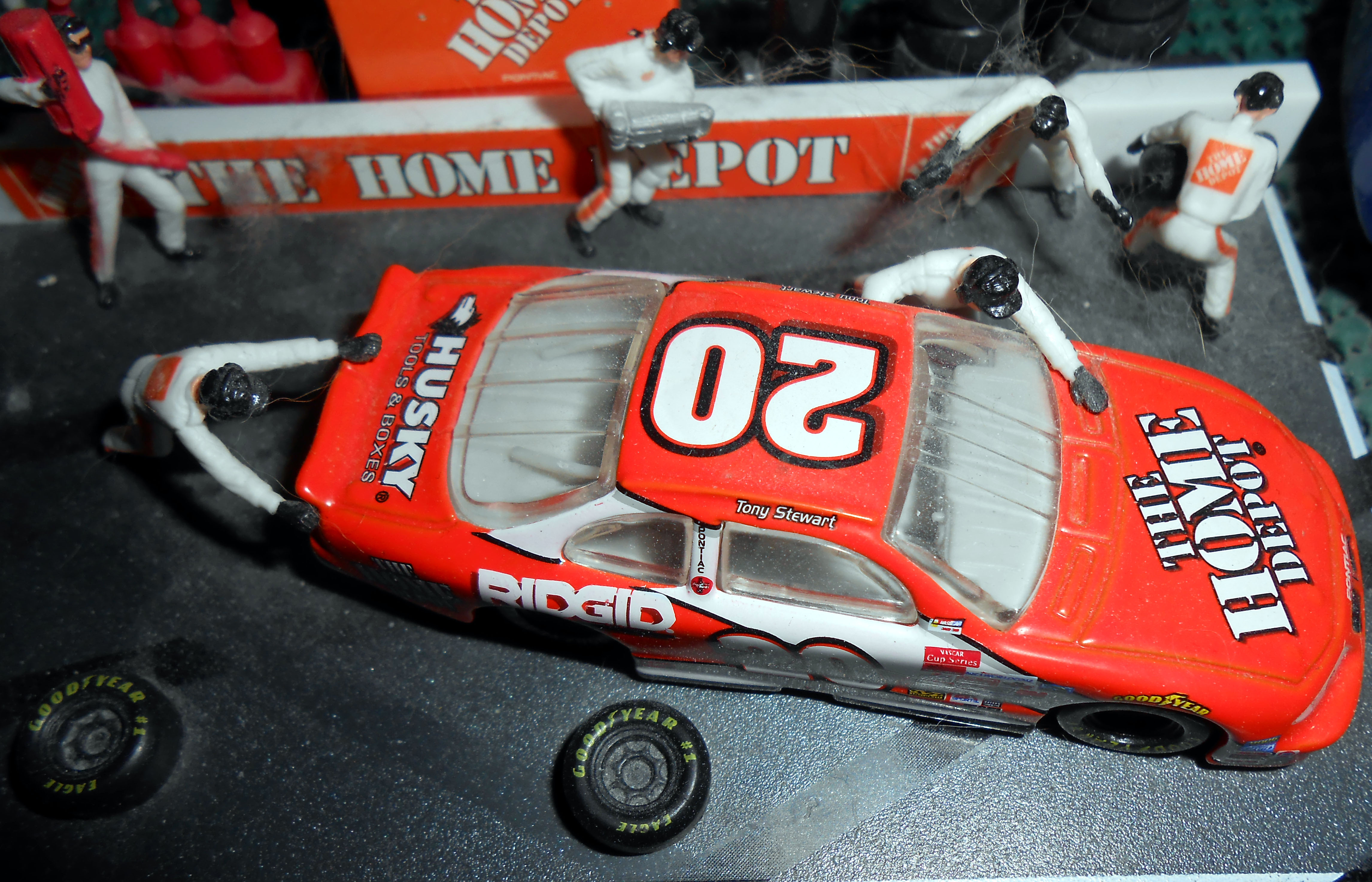
Tony "Smoke" Stewart is a three-time NASCAR Champion and ambassador for all forms of racing. But as owner of a million dollar racing empire some mat question why he still races on dirt and risks injury or worse.  Photo R. Anderson
Tony “Smoke” Stewart is a three-time NASCAR Champion and ambassador for all forms of racing. But as owner of a million dollar racing empire some might question why he still races on dirt and risks injury or worse.
Photo R. Anderson

I am of course talking about three-time NASCAR Champion Tony “Smoke” Stewart.

Stewart broke the tibia and fibula of his right leg in a sprint car crash in Iowa Monday night and will need a second surgery on his right leg in the coming days.

The injury will force Stewart out of his NASCAR ride for the first time since he joined the Cup Series in 1999. How long he stays out of the car remains to be seen.

I have been a Smoke fan pretty much ever since he entered the Cup Series for Joe Gibbs Racing.

While he has certainly had a bumpy relationship with the media at times, I enjoy his passion for the sport and the fact that he speaks his mind and seems to genuinely care for those around him.

Those are the same traits that I find in Kyle Busch who is a former teammate of Smoke and another driver that I follow.

I certainly wish Smoke a speedy recovery from his recent injury since I think the garage area and racing in general is certainly better off with him there than not.

As is the case any time an athlete is injured away from their main sport, there are those who say that athletes should not compete in areas other than their main job because of freak injuries just like this.

Tony Stewart broke is leg in two places Monday night putting the rest of his current season in jeopardy.  Photo R. Anderson
Tony Stewart broke is leg in two places Monday night putting the rest of his current season in jeopardy.
Photo R. Anderson

I don’t really share that particular point of view. Athletes by their nature, especially the ones who make it to the highest levels of sport, are highly competitive people.

That competitive fire cannot be turned off and only show up on game time or in Stewart’s case whenever the green flag drops.

And yes that is the same competitive fire that causes some athletes, such as the suspended PED using ballplayers whose names shall not be named here, to break the rules to gain any advantage that they can in their quest to be the best.

The competitiveness needs to be fed and for Stewart and many other drivers that fuel comes through racing on dirt tracks like the one he was injured on. Race the same course hundreds of times and there are likely to be no injuries but roll the dice, or the car enough times, and injuries will occur.

That does not mean that people should never take chances or feed the passion and the competitive fire that burns within.

A few years back Stewart’s teammate at the time, Denny Hamlin, blew out his knee playing basketball. While Hamlin’s injury occurred on a court and not a track it still meant that he missed time from is “day job.”

The competitive spirit that drives Tony Stewart to risk his career on the race track is described in his biography. Stewart, like many drivers on the circuit simply put were born to race. Or has Ricky Bobby would say, "They wanna go fast." Photo R. Anderson
The competitive spirit that drives Tony Stewart to risk his career on the race track is described in his autobiography. Stewart, like many drivers on the circuit simply put were born to race. Or as Ricky Bobby would say, “I wanna go fast.”
Photo R. Anderson

The world of sports is full of stories of athletes missing time due to freak injuries so saying that NASCAR drivers cannot race in other non NASCAR sanctioned races, as some will likely suggest, is clearly not the answer since injuries can happen anywhere.

The fact is people are injured all of the time in day to day living so risks are not limited just to the track and other “high risk” scenarios.

I could just as easily turn an ankle by tripping over something on the way to the fridge to get some iced tea.

Granted that is an extreme example, but I would much rather be the type that has a cool story to share about any potential injury incurred than being the type to say, “I tripped over my cat and sprained my back.”

I have little doubt that once the leg is healed Smoke will go right back to racing on dirt tracks across the country since it is in his nature to do so and it fuels his passion for racing.

We should all be so lucky to find things to be passionate about in our daily non dirt track racing lives.

Now if you’ll excuse me, I am going to attempt an injury free walk to the fridge to get some iced tea, wish me luck.

Copyright 2013 R. Anderson

The Day That Separates the Contenders from the Pretenders

Today at 4 p.m. Eastern Time marks the Non-waiver Trade deadline for Major League Baseball.

This magic day is when teams that feel like they are missing one or two pieces to make a run deep into the playoffs make deals with teams that are nowhere near playoff level and want to shed expensive contracts and look towards the following season.

Often times a player is traded as a “50-game rental” since their contact expires at the end of the season and they will become a free agent. Other players are traded with several years left on their contract.

A third type of trade involves a player getting moved to a new team with the old team still paying a portion of the salary of the player that is no longer on their roster. I have never really understood that type of trade since I think that if a player is traded the new team should be responsible for all of the related salary.

But for the contenders the trades are deemed worthy as the hope is the player will lead them to a World Series Championship. Sometimes the late season trades work and sometimes they don’t.

For the players on the trade bubble the days and weeks leading up to today can be very stressful as they wonder where they will end up finishing the season. The pending trades of players also affects how they are used leading up to any potential trade.

With the trade deadline looming many players on the trade rumor mill were taken out of the lineup for games on trade deadline eve. After all no one wants to risk a freak injury negating a trade at the 11th hour.

After pitching on Opening Day as the ace of the staff, Bud Norris of the Houston Astros was awaiting his fate at the trade deadline. Photo R. Anderson
After pitching on Opening Day as the ace of the staff, Bud Norris of the Houston Astros was awaiting his fate at the trade deadline.
Photo R. Anderson

For the Astros this meant that Bud Norris was taken out of the rotation for his scheduled start against the Baltimore Orioles last night. It is very likely by the time you are reading this Norris will have a new team name on the front of his jersey.

While many teams from the Atlanta Braves to the Pittsburgh Pirates have been mentioned as a potential landing spot for Norris but no one seems to know for sure who the winning team will be.

The only thing certain is that much as they have the past three years the Astros want to get rid of their highest paid players and trade them for minor league prospects and this year that honor of highest paid player to get rid of falls on Norris.

I actually hope that Norris gets traded to a contender since watching him pitch a strong game only to have the bullpen blow it in the late innings is getting very painful to watch.

While I do not consider Norris the ace of a staff I think he would make a good middle of the rotation pitcher for a team with a strong rotation.

And Norris could also potentially join the list of former Astros who were traded and became World Series Champions. Lance Berkman accomplished that with the St. Louis Cardinals and Hunter Pence got his ring with the San Francisco Giants. So it definitely seems like if a player wants to win their best bet is to be traded.

Carlos Lee was traded from the Houston Astros to the Miami Marlins at the trade deadline last year as part of an annual housecleaning and payroll dump that has become commonplace at Minute Maid Park. Photo R. Anderson
Carlos Lee was traded from the Houston Astros to the Miami Marlins at the trade deadline last year as part of an annual housecleaning and payroll dump that has become commonplace at Minute Maid Park.
Photo R. Anderson

While the final destination for Norris remains up in the air at the time of this writing the Astros have already been active in the trade market. In fact, earlier in the week Astros closer Jose Veras was traded to the Detroit Tigers for some Class-A level talent that may or may not ever see a Major League game.

Of course one could certainly argue that as bad as the Astros have been this season they really didn’t need a closer anyway since the number of games that they were in a save situation was certainly a small number.

So the closer was sent away and an already porous bullpen was asked to try to pull together and not blow so many leads.

That is the risk teams take in the trade the present and hope for a brighter future philosophy.

The Pirates have used that model for over two decades before finally posting winning records. To put that in perspective there were people who were born and graduated community college without ever seeing the pirates have a winning record.

While the Astros have not had quite as many years of futility so far there is very little to give one much confidence of that changing any time soon. So the process of acting as a feeder club to the contenders while rolling the dice on unproven talent will continue for the foreseeable future.

And with far more pretenders than contenders each year the non-waiver trade game will continue year after year until a time when the playing field is more level between the haves and the have nots.

Now if you’ll excuse me, I am off to check the wire to see what washed up prospects the Astros are targeting next.

Copyright 2013 R. Anderson

Two Sides of Sportsmanship on Display This Week

Earlier this week the baseball world was rocked by the news that former National League MVP Ryan Braun basically lied repeatedly regarding his use of performance enhancing drugs. Braun was suspended for the rest of the year and people started wondering whether he could ever regain the respect of the Milwaukee Brewers fans when he does return next season.

Normally this type of admission would carry through for the entire week in the media as the sports world anxiously awaits news of the next stars to fall. But a funny thing happened Wednesday night to help restore one’s faith in the fact that not all of the baseball players are selfish millionaires cheating the system for their own gain.

Of course most rationale people know that there are still many good players taking the field but sometimes it is good to be reminded of such things.

That reminder came in the form of the reaction to a gruesome injury at the New York Mets ballpark that had been the sight of the All Star Game earlier in the month.

The Atlants Braves were dealt a blow Wednesday night when pitcher Tim Hudson broke his ankle. The response after that occurred showed there are still good players left in the game during a week where much of the news centered on suspensions for cheaters. Photo R. Anderson
The Atlanta Braves were dealt a blow Wednesday night when pitcher Tim Hudson broke his ankle. The response after that occurred showed there are still good players left in the game during a week where much of the news centered on suspensions for cheaters.
Photo R. Anderson

While covering first base on a routine play that he had probably done hundreds of times in his career Atlanta Braves pitcher Tim Hudson put a little too much of his foot on first base leaving New York Mets left fielder Eric Young Jr little room to avoid contact with Hudson’s outstretched foot.

Young hit Hudson’s foot at full speed causing it to bend at an angle that feet just aren’t meant to bend. Watching the replay of the contact I knew right away that something bad had happened. While it was not necessarily a career ending injury, it was definitely a season ending injury based on what I saw on the replay.

This assessment of the severity of the injury was not based on extensive study in medical school, although I did take a few seminars in sports medicine, but was based on years of covering games where I had seen countless athletes get hurt.

That firsthand knowledge has allowed me to guess with pretty accurate results the type of injuries and even the sound that is made when the injury occurs. One never forgets the sound broken bones and torn tendons make once you have heard them. They are the type of sounds that are truly haunting.

So, right now you are wondering when I will get to the part about the good news and the sportsmanship element of Wednesday night instead of all of the gory details of what did in fact turn out to be a broken ankle that will require season ending surgery.

The element of sportsmanship comes in the reaction of Young after he realized that Hudson was on the ground in pain.

Young, who was ruled out on the play, went right to Hudson’s side and started consoling him. Even after the team trainers and paramedics arrived, a visibly shaken Young stayed by the side of the fallen Hudson.

Young, a professed Christian, could even be seen rubbing the cross on his chain and saying a prayer for Hudson while the medical staff attended to him.

Once Hudson was placed on the golf chart to make the trip around the warning track that no athlete wants to make Young came up to Hudson and shook his hand and said a few words to him before turning to head into the Mets dugout. On the way to the dugout Young could be seen wiping tears from his eyes.

Now, there was nothing dirty about the play and all of the people saying that Young should have done something to avoid contact with Hudson are deeply diluted. Had Young tried to change course it is quite possible that he would have been the one with an ankle injury instead of Hudson. It was just a freak accident that while rare does happen from time to time.

So instead of blaming Young for the injury people should focus more on his reaction. After realizing that a fellow competitor was down Young went to his side. That shows the close knit fraternity of baseball that regardless what team name is on the front of the jersey the good players still help each other out.

There is certainly a time to be competitive with one another but as Young showed there is also a time to be compassionate towards one another.

So while I feel bad that it took an injury of this nature to bring it out, and I certainly join others in wishing Tim Hudson a speedy recovery from his injury, it was nice to see the compassion shown by Eric Young Jr. to help restore my faith in the belief that not all of the players on the diamond are self-centered cheaters like Ryan Braun and Alex Rodriguez have shown themselves to be.

I still want to believe, like the younger version of me did, that ballplayers are by and large good people who can be admired for playing the game the right way but it seems the older I get the harder it is to tell which players are worthy of admiration and which ones should be pitied.

Eric Young Jr. showed he is a player to be admired and hopefully more players took notice and will respond in kind if they are ever placed in the same position.

Now if you’ll excuse me, I have a trip to the beach to prepare for.

Copyright 2013 R. Anderson