Category Archives: Major League Baseball

Wallet Lost, Good People Found

The other day, I did something that I have never done at a Ballpark, and hope to never do again.

That something was becoming separated from my wallet.

Through the years, I have attended games at many Ballparks from Little League to Major League and every league in between.

At each of those games, my wallet and I remained attached at the back pocket from the time I entered the Ballpark until the time I left.

Sure the wallet would come out from time to time to purchase concessions or souvenirs, but after each transaction was completed, the wallet would return to the security of Mr. Pocket despite the discomfort of sitting on a wallet on a hard plastic seat.
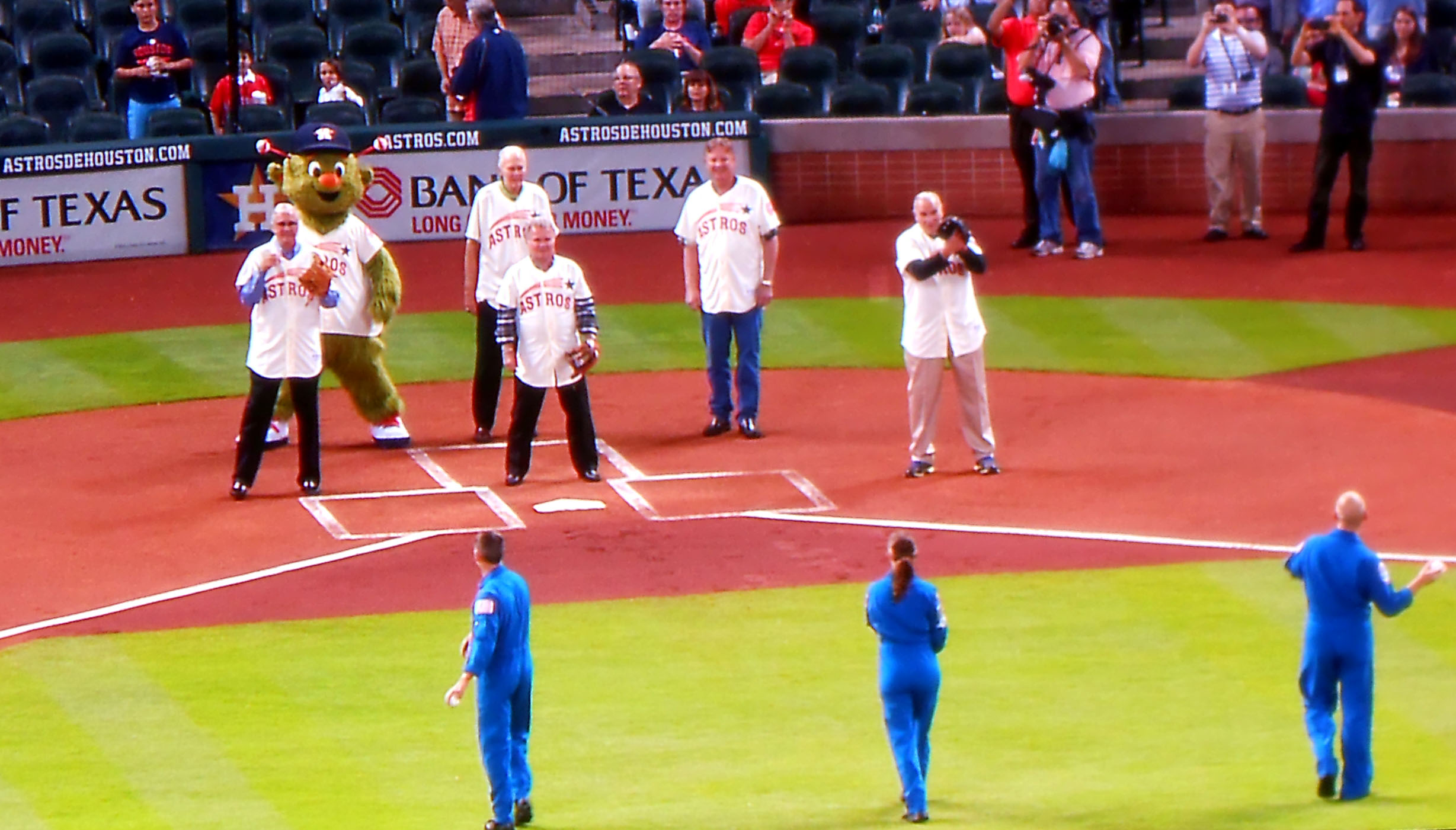
Saturday's Houston Astros game started with three astronauts throwing out ceremonial pitches and ended with a frantic search for a lost wallet. Photo R. Anderson
Saturday’s Houston Astros game started with three astronauts throwing out ceremonial pitches and ended with a frantic search for a lost wallet.
Photo R. Anderson

For some unknown reason during a recent visit to Minute Maid Park, my wallet decided that it no longer wanted to be in my pocket and decided to venture out on its own.

I did not realize that my wallet had gone on a walkabout until I was standing on the lower concourse after leaving my seat on the upper concourse.

Upon first realizing that my wallet was no longer tucked safely inside my pocket, my first thought was that perhaps I had been the victim of a pick pocket since several people had bumped into me during my trek through the mass of humanity within the facility.

My next thought regarding my lost wallet was that perhaps I was not the victim of a pick pocket and instead it had fallen out somewhere along my journey between the highest point of the Ballpark and the lowest.

Shortly after watching George Springer cross home plate after a solo home run I was greeted by the sinking feeling of an empty back pocket where my wallet should have been. Photo R. Anderson
Shortly after watching George Springer cross home plate after a solo home run I was greeted by the sinking feeling of an empty back pocket where my wallet should have been.
Photo R. Anderson

I decided that the only course of action was to retrace my steps and hope that the needle that was my wallet could be located within the hay stack that was Minute Maid Park.

As I began my sprint back to the upper deck, I allowed my thoughts to drift to the worst case scenario that at that very moment someone had my wallet and was up to no good.

While I was certainly not hoping for a worst case outcome, I knew that I needed to prepare myself in case that turned out to be what happened.

I knew that in this scenario whatever cash I had in the wallet was gone along with my driver’s license and credit cards.

There was nothing I could do about the lost cash, so I focused on the credit cards and who I would need to call to report the cards as stolen. While it would be a hassle to call them I knew that it was the only way to protect myself in the event the cards were stolen.

Ironically, it was not the potential loss of cash, nor the loss of the credit cards that had me the most upset.

The view of the grounds crew raking the field was nice. Sprinting from the lower bowl to the upper deck in record time was not quite as nice. Photo R. Anderson
The view of the grounds crew raking the field was nice. Sprinting from the lower bowl to the upper deck in record time was not quite as nice.
Photo R. Anderson

The thought that troubled me the most as I ran up the three sets of escalators, was that I was going to have to go to the Department of Motor Vehicles to get a new driver’s license.

It is sad that the DMV was the place I most dreaded, but as anyone who has spent an afternoon waiting in line can attest it really is a fate worse than lost cash or credit cards.

Speaking of the escalators, as I approached the usher at the top of the last one he looked briefly like he was going to tell me not to run but I must have had a look of either shear motivation or madness that told him to step aside and let me through.

Clearly I was a man on a mission.

About a hundred or so paces from the escalator was the tunnel that led to the section where my seat had been.

After turning the corner and entering the tunnel I saw another usher holding something brown that looked surprisingly like my walkabout wallet.

As I got closer I could tell that the light at the end of the tunnel, or in this case the brown object in the usher’s hand, was in fact my wallet.

The view from the top where a kind stranger helped ensure a wallet lost would be a wallet found. Photo R. Anderson
The view from the top where a kind stranger helped ensure a wallet lost would be a wallet found.
Photo R. Anderson

Although I was out of breath from my multilevel sprint I managed to utter the words, “That is mine, thank you.”

Without a word in return the usher gave me my wallet and I turned around to head back to the lower concourse.

All of the worst case scenarios that I had feared, including that trip to the DMV, were no longer in danger of coming to pass.

My wallet, complete with cash, credit cards and driver’s license was once again safely in my pocket.

I still do not know how my wallet managed to extradite itself from my pocket, nor do I know exactly who found it and gave it to the usher.

What I do know, is that someone in Section 410 of Minute Maid Park did the right thing and turned a situation that could have been very bad into something very good.

While I certainly don’t wish the stress of a sprint to find a lost wallet on anyone, sometimes it is those things that are needed in order to see the big picture.

Even though newspapers and television newscasts seem to be filled with only the stories of all of the bad things happening in the world, now and then it is important to be reminded that there are still good people in the world.

So to whoever found and returned my wallet last Saturday night I say, “thank you,” not only for the return of the wallet but for also showing a complete stranger an act of kindness and compassion.

Now if you’ll excuse me, I am off to buy some shorts with a Velcro closure on the back pocket to keep my wallet from further unapproved walkabouts.

Copyright 2015 R. Anderson
Major League Baseball Takes Time Today to Honor a Trailblazer

We are a country that enjoys commemorating achievements in all shapes and sizes.

Some call it the American spirit.

Others might call it an attempt to ensure that the sacrifices of those that have gone before us are remembered long after they are no longer walking amongst us.

Just last week the 150th anniversary of the end of the United States Civil War was celebrated at Appomattox Court House, Virginia where General Robert E. Lee surrendered to General Ulysses S. Grant.

While Appomattox Court House is certainly among the central historical places in America, memorials of all shapes and sizes can be found from sea to shining sea as a way of helping to ensure that history is not forgotten.

Of course, sometimes a memorial is not made out of brick and stone but is instead comprised of flesh and blood.

Today marks one of those occasions to remember and honor a flesh and blood memorial who, against all odds, changed the face of the country.

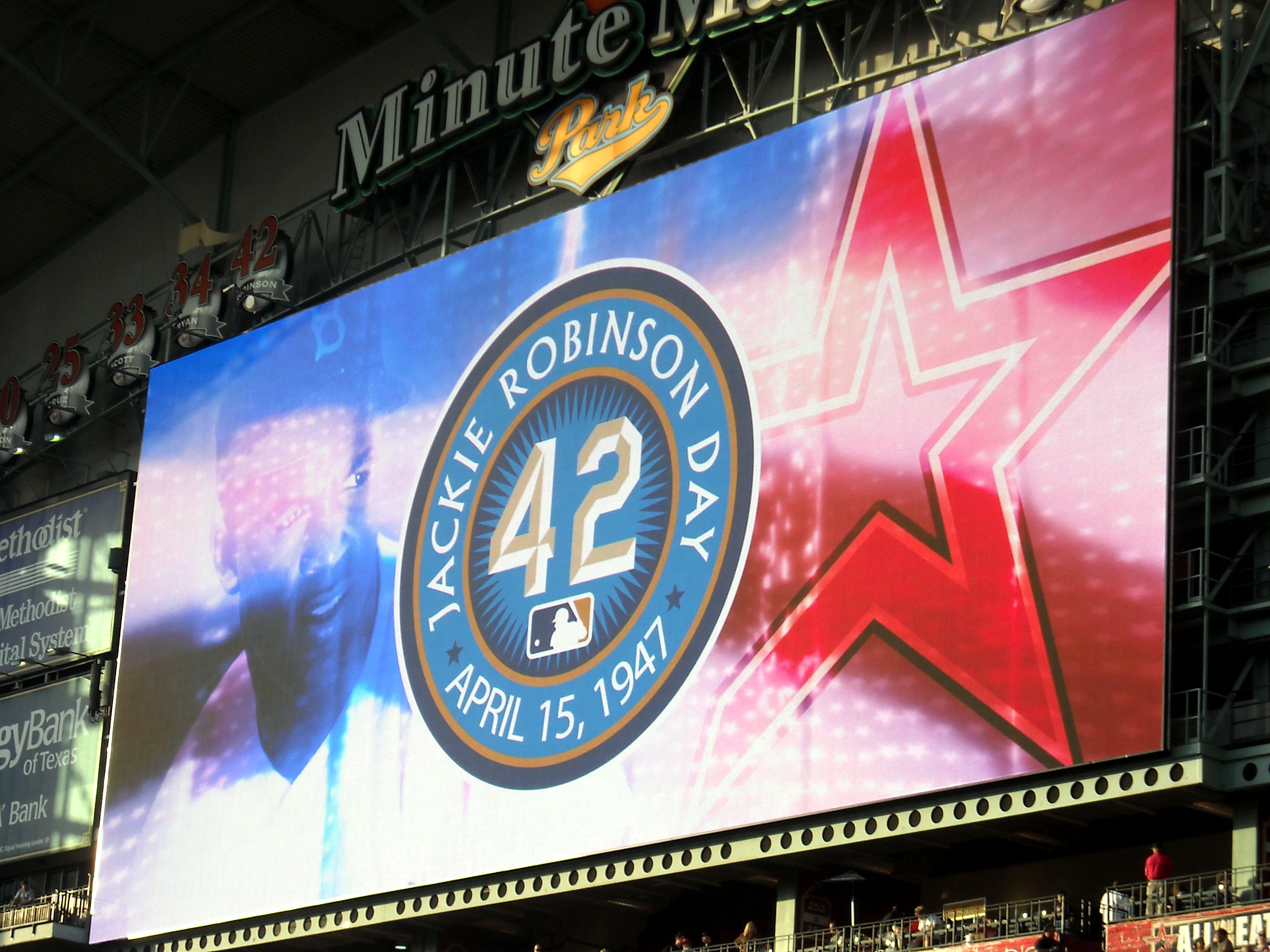
Each year on April 15 Major League Baseball teams stop to remember Jackie Robinson. Photo R. Anderson
Each year on April 15 Major League Baseball teams stop to remember Jackie Robinson.
Photo R. Anderson

Aside from being Tax day, April 15 is also Jackie Robinson Day. Jackie Robinson Day is a day sat aside to pay homage to an achievement of courage and determination in breaking the color barrier in Major League Baseball.

While many fans may have only heard of Jackie Robinson following the release of the movie 42, his impact on the game of baseball stretches back nearly 70 years.

On April 15, 1947 Jackie Robinson became the first African American to step foot on a Major League Baseball field when he suited up for the Brooklyn Dodgers.

The world of baseball for Jackie Robinson, and many other players like him, was far different from the world of baseball today.

I am not referring to jumbotrons and jumbo hot dogs, or any of the other things that have found their way into the modern game of baseball. I am not even talking about the designated hitter.

Prior to 1947, there were no minority players on any of the teams in the highest level of professional baseball. It took an owner willing to do what others wouldn’t in Branch Rickey, and a player willing to withstand insults from on the field and in the stands in Jackie Robinson, to pave the way for those that came behind them.

For people of a certain age, like me, it is nearly impossible to picture a segregated baseball diamond. From my earliest recollections there were people of all shapes and sizes and races on the field.

The number 42 hangs in all 30 Major League Baseball Ballparks in honor of Jackie Robinson who broke the color barrier on April 15, 1947.
Photo R. Anderson

Look at the rosters of the 30 MLB teams today and one will find players from six continents.

None of that would have been possible without someone taking the first step to desegregate the diamond.

So, it is fitting to take time to honor Jackie Robinson’s sacrifice and to ensure that generations who were not alive back in 1947 can learn the story and know that without the sacrifices of people like Jackie Robinson the world would be an entirely different place.

One of my favorite quotes is “Those who cannot remember the past are condemned to repeat it.” It was first stated in the early 20th century by George Santayana, but the phrase is still as true today as it was when first spoken. Society must continue to learn from history so as not to repeat the mistakes of the past.

During the annual celebration of Jackie Robinson, there are always a select few who will state in various outlets Robinson’s inclusion in the Baseball Hall of Fame was based solely on him being first to break the color barrier and is not reflective of his playing ability.

Of course, a quick look at his career statistics show that based on the merits of his play alone Jackie Robinson is every bit of a Hall of Fame caliber player and is included as much for what he did as a player as well as what he did as a trailblazer.

As part of Jackie Robinson Day, each player on every team wears the number 42 as a show of respect and solidarity.

In 1997, on the 50th Anniversary of Jackie Robinson’s first game, Major League Baseball retired the number 42 on all teams in honor of Jackie Robinson. As part of the number retirement players who were still wearing 42 were grandfathered in and allowed to keep wearing the number for the remainder of their careers.

Following Mariano Rivera’s retirement at the end of the 2013 season no player will ever again wear the number 42 in Major League Baseball.

There are still trails to blaze in a variety of areas and memorials will continue to be built for those individuals who conquer that new ground. But each new trail that is blazed is built upon the foundation of those who showed the way through their own courage.

History is a great thing to honor but the promise of the future can be equally exciting.

Now if you’ll excuse me, I need to figure out how to keep track of all of these 42’s on my scorecard.

Copyright 2015 R Anderson

Pace of Play Shows Nothing Gold Can Stay

When I was a senior in high school, I had to memorize the Robert Frost poem “Nothing Gold Can Stay” as part of an English assignment.

Whenever I am dealt setbacks, or encounter things that make no sense to me logically, I often think of that poem and its message of the inability of golden things to last forever and the inevitable decay that takes their place.

I was reminded of that poem the other day when I read a story about a lake near Boulder, Colorado that contained thousands of goldfish.

Now before you bemoan the fact that your local swimming hole is not filled with thousands of goldfish, rest assured that goldfish are not native to Colorado either.

It seems that at some point someone put a few pet goldfish into the lake. Over time, those goldfish begat more goldfish which ushered in the circle of life that the animated lion and his friends sang about.

An unknown number of pet goldfish were placed in a Boulder, Colorado lake and have now swarmed to a school of thousands. Photo R. Anderson
An unknown number of pet goldfish like these were placed in a Boulder, Colorado lake and have now swarmed to a school of thousands.
Photo R. Anderson

As well intentioned as the person, or persons, were when they added the goldfish to the lake, the resulting swell in goldfish population has led Colorado wildlife officials on a search for a way to remove the invasive species.

Most likely the remediation plan will result in the death of the goldfish either through draining of the lake, or electroshock since someone has determined that while goldfish have a place in man-made aquariums, they do not belong in a man-made lake.

That’s right, the entire lake is invasive itself if one really stops to think about it.

Personally, I think the people of Boulder are sitting on a gold mine and missing a golden opportunity. I mean how many other towns can say that they have a huge goldfish pond?

I would leave the goldfish where they are and promote the lake as a golden pond where people young and old can come and see goldfish that have grown much larger than they would have grown were they swimming around in a little fish bowl.

But sometimes people fail to see the gold that is in front of them. Instead bringing on the decay by invoking change when no change is needed.

Take for example the efforts to speed up the game of baseball.

For the past 10 seasons or so, the average length of a Major League Baseball game has increased. Last season the average duration of a nine-inning baseball game clocked in at a record 3 hours, 2 minutes, up from 2 hours and 33 minutes in 1981.

As such, Major League Baseball is seeking to shorten the game through pace of play initiatives such as requiring a batter to keep at least one foot in the batter’s box at all times.

Players who step out of the batter’s box will be fined since they are lengthening the game by taking too much time between pitches.

I do not think that batters stepping out of the box is a bad thing. I often enjoy some of the comical routines that players do between pitches.

Former Houston Astro Hunter Pence was an especially fun player to watch in the batter's box since he took his batting helmet off between pitches and rubbed it on his elbow each time without fail. photo/R. Anderson
Former Houston Astro Hunter Pence was an especially fun player to watch in the batter’s box since he took his batting helmet off between pitches and rubbed it on his elbow each time without fail.
photo/R. Anderson

Hunter Pence was especially fun to watch when he was with the Houston Astros. Pence took his batting helmet off between pitches and rubbed it on his elbow each time without fail.

If I were going to change something about the game to make it go faster, I would limit the number of pitching changes that were allowed.

The trend of pitching specialists who only face a single batter is ludicrous and is the real reason games are longer.

Unless an injury replacement is needed, teams should be limited to no more than four pitchers in a nine-inning game.

Additional pitchers could be used in an extra inning game. However, I see few reasons why a team cannot field a competitive nine-inning game with four pitchers.

Speaking of pitchers, another time saving innovation in the pipeline is a pitch clock where pitchers have a set amount of time to pitch. Go over the pitch clock and the batter is awarded a ball.

The Atlantic League of Professional Baseball was the first to use a pitch clock last year and this year pitch clocks have made their way into affiliated Triple-A and Double-A Minor League Baseball Ballparks.

Under the pace of play rules, Minor League pitchers have 2 minutes and 25 seconds to begin their windup or come to set between innings, and 20 seconds between pitches.

The Atlantic League of Professional Baseball was the first to use a pitch clock when the Sugar Land Skeeters and other teams implemented it last year. Photo R. Anderson
The Atlantic League of Professional Baseball was the first to use a pitch clock when the Sugar Land Skeeters and other teams implemented it last year.
Photo R. Anderson

Part of the beauty of baseball that is getting lost in all of this is that baseball is the only professional sport without a game clock of any kind.

The action is controlled by the number of outs, not the number of seconds.

I see no reason to change that.

As for some other sports that do have clocks, they are close to the length of a baseball game and do not offer any more on field action.

In 2010, the Wall Street Journal conducted a study on the amount of action in a National Football League game and discovered that 11 minutes of the average NFL game can be considered action.

For the purpose of the study, action was considered the time that the ball was snapped until the play was whistled dead by the referees.

While listening to people shout “Omaha, hut, hut” can be fun, it was not listed in the action category.

By comparison, the Wall Street Journal determined that a fan will see 17 minutes and 58 seconds of action over the course of a three-hour MLB game.

Items considered action as part of the Journal’s study included balls in play, runner advancement attempts on stolen bases, wild pitches, pitches, home run trots, walks and hit-by-pitches, and pickoff throws.

With the average MLB ticket price far below the average NFL ticket price, it is clear that baseball offers fans much more bang for their buck and nearly eight more minutes of action.

If something is not broken there is no need to tinker with the formula.

And if someone does not have the attention span to sit through a three-hour baseball game, no amount of tinkering can fix that.

Koi are common in fish ponds, pet goldfish not so much. Photo R. Anderson
Koi are common in fish ponds, pet goldfish not so much.
Photo R. Anderson

Instead, continued tinkering will likely alienate long term fans.

Just as the Colorado goldfish should be left to swim out their days in peace, the game of baseball should be left to unfold as it has for the past century or so without adding a pitch clock or whatever other effort is proposed in the name of time saving.

But of course, as Robert Frost taught me all those years ago in Mrs. Phillips’ English class, nothing gold can stay.

Now if you’ll excuse me, it is time to feed my fish.

Copyright 2015 R. Anderson

The Day When Even the Infield Grass Seems Greener

For those of you living under a rock, or perhaps more appropriately under a blarney stone, yesterday was St. Patrick’s Day.

St. Patrick’s Day is named after Saint Patrick, one of the patron saints of Ireland. The actual origin story and legends surrounding St. Patrick are varied and tend to depend greatly on the source material one looks at.

There is of course the legend about St. Patrick driving all of the snakes out of Ireland. However, most scholars and scientists agree that there is no evidence in the historic or fossil record of snakes ever being in Ireland to begin with. So, the likelihood of a single man driving them all off of the island is highly improbable.

Before he was Bond, James Bond, Sean Connery was chasing after pots of gold in a movie that has become a much see around St. Patrick's Day. Photo R. Anderson
Before he was Bond, James Bond, Sean Connery was chasing after pots of gold in a movie that has become a much see around St. Patrick’s Day.
Photo R. Anderson

I guess now is also a good time to mention that despite Walt Disney’s assurances and “documentary” techniques King Brian and Darby O’Gill also didn’t really exist despite assertions to the contrary made in Darby O’Gill and the Little People.

What is agreed upon, is that St. Patrick was born in England in the late 4th century A.D. and was kidnapped as a child and brought to Ireland.

He escaped his captors after six years and returned to Ireland as a missionary combining Irish pagan beliefs with Christian sacrament while devising the Celtic Cross.

In the centuries that have followed, St. Patrick’s Day has been less about the man and more about green clothes, green beer, green hats and pretty much anything else green.

Every St. Patrick’s Day, rivers and lakes around the globe turn green not from algae but from food coloring poured in by the gallon full as a celebration of the holiday.

Massive amounts of corned beef and cabbage will also be consumed as a way to celebrate the day.

Over the past couple of years, the green movement has moved to the fields of Major League Baseball as well.

No, I am not talking about the grass on the fields.

I am not even talking about the number of teams who are now encouraging recycling and other “green initiatives” inside their ballparks.

What I am talking about is the green that is popping up on the players.

For the past few years the Spring Training games on St. Patrick’s Day have included teams wearing green uniforms and hats.

Spring Training games will be a bit greener today as various teams get in the spirit with green hats and uniforms for St. Patrick's Day. Photo R. Anderson
Spring Training games will be a bit greener today as various teams get in the spirit with green hats and uniforms for St. Patrick’s Day.
Photo R. Anderson

The first team that I recall, going green was the Boston Red Sox.

The green uniforms and hats seemed an obvious choice based on the amount of Irish American fans in the Boston area.

Other teams followed the green trend and soon it became a league wide tradition as part of the day where everyone can claim to be a little Irish.

The teams that go green each year vary with some teams forgoing the green for their more traditional colors.

The first time I saw a televised game with the Red Sox wearing the green uniforms I actually thought there was something wrong with my televisions set since the sight of teams in colors other than their normal ones can take some getting used to.

The full circle marketing of St. Patrick’s Day to include green items for the fans was just a matter of time since Major League Baseball, like most successful businesses, has made a habit of capitalizing on every opportunity to make money.

While the green gear is popular with the fans, it also allows the players to try something new in Spring Training.

There are special uniform nights throughout the season but green uniform day is the only one that falls during Spring Training.

So as a public service announcement, next time March 17th rolls around do not adjust your set when you are watching that Spring Training game.

Your eyes are not playing tricks on you. The players really are wearing green.

Now if you’ll excuse me all of this talk about green things has me in the mood for some green eggs and ham.

Copyright 2014 R Anderson

Baseball Movie Monday is All about Second Chances this Week

Editor’s Note: In the spirit of seeking sunshine during a gray winter, and to help usher in the upcoming baseball season, we will be featuring baseball movies every Monday between now and Opening Day. Today’s choice of silver screen Baseball goodness looks at what happens when one gets a second chance to follow a dream.

Today we return to the world of real events captured on film as part of our journey to what we feel are the best baseball movie of all time.

While there is certainly no shortage of baseball movies about real people, the quest for a second chance often rings throughout the narrative of many of these movies. That is certainly the case with The Rookie starring Dennis Quaid.

While I never really bought into the fantasy elements of Angels in the Outfield, there was one Disney baseball movie deemed worthy to join my collection and that movie was The Rookie.

The Rookie tells the true life tale of a high school baseball coach from Texas who gets to live out his dream of pitching in the big leagues for the Tampa Bay Devil Rays long after he thought that his dream had been shattered following an injury.

As a fan of the Devil Rays turned just plain Rays, I try to soak up as much of the team’s history as possible.

The real life story of a Texas teacher turned Major League pitcher portrayed in the Rookie is one of the feel good movies about baseball.  Photo R. Anderson
The real life story of a Texas teacher turned Major League pitcher portrayed in the Rookie is one of the feel good movies about baseball.
Photo R. Anderson

Granted there are only about 15 years of history so far, but I have lived each one of those years with the team and can remember covering the announcement of their birth into the league. So, I guess you could say they hold an extra special place in my heart.

After being drafted by the Milwaukee Brewers, Jim Morris (played by Dennis Quaid), blows out his shoulder ending his hopes of achieving his lifelong dream of pitching in the Major Leagues.

Fast forward a few years to 1999, and Morris is now married with three children, is a high school science teacher, and is the head baseball coach in Big Lake, TX.

After discovering that Morris can still bring the heat, his players offer him a deal that if they make the state playoffs, Morris will try out again for the Major Leagues.

After the Owls make the playoffs, Morris tries out for the Devil Rays and after being signed to a Minor League contract is assigned to the Class AA Orlando Rays (now the Montgomery Biscuits). After a quick stop in Orlando, Morris moves up to the AAA Durham Bulls.

In September, Jim is told that the Major League club has called him up, and that they will be playing in Texas against the Rangers.

In true Hollywood fashion, Morris makes his Major League debut against the Rangers in front of many of his friends and family who traveled to see his debut.

Morris pitched for the Devil Rays for a couple of years before finally hanging up his glove for the final time.

The movie, and real life story of Jim Morris, show that it is never too late for one to chase their dreams.

That is an important lesson for everyone to keep in mind and is what makes The Rookie worthy to be on our countdown.

Now if you’ll excuse me, all of this talk about the Rays has me in the mood to watch some DJ Kitty videos.

Copyright 2015 R. Anderson