Category Archives: Houston Astros

Hinchcliffe Wreck Shows Risk of Injuries are Part of Everyday Life for Athletes

If one really stops to think about it, every day life is full of risks .

There is the risk of stubbing one’s toe while fumbling in the dark all the way to the risk that someone will run into the back of your car while you are stopped at a light.

For professional athletes, there are the every day toe stubbing risks that the average person faces along with the risk that in some cases they might be seriously injured or even die at work due to the inherent risks associated with what they do for a living.

James Hinchcliffe (shown in Winner's Circle after the 2013 Grand Prix of Houston) recently reminded people that driving Indy Cars is risky business. Photo R. Anderson
James Hinchcliffe (shown in Winner’s Circle after the 2013 Grand Prix of Houston) recently reminded people that driving Indy Cars is risky business.
Photo R. Anderson

Of course, police officers, firefighters, and members of the military are among the many professions who also put their life at risk.

So, in no way do I want to come across as saying that athletes are the only ones with risky professions.

There are countless men and women working tirelessly at dangerous jobs every day who deserve our thanks for keeping us protected.

Usually their jobs do not have them in arenas full of screaming fans while they perform the risky work though. In that way professional athletes really are in a league of their own when it comes to performing risky behavior in front of the masses.

One of those athletes who does risky work in front of the masses, Indy Car driver James Hinchcliffe, is in the Intensive Care Unit of an Indiana hospital following a violent crash during practice for the Indianapolis 500 Monday.

Hinchcliffe, or Hinch as he is known to many of his fans, suffered a puncture to the left upper thigh after a piece of the car’s suspension assembly pierced the driver cockpit, or tub, and went through his leg causing severe soft tissue damage and rupturing arteries.

According to some published reports, after his car’s right front suspension failed, Hinchcliffe hit the wall with a force of 125 Gs and was likely traveling more than 220 mph when he hit the wall. It should be noted that G forces above 100, even in short bursts, can be fatal in some cases.

Unlike in other sports the same safety team travels to all Indy Car races. It is the quick work of that team that is being credited with saving the life of James Hinchcliffe following a wreck Monday. Photo R. Anderson
Unlike in other sports the same safety team travels to all Indy Car races. It is the quick work of that team that is being credited with saving the life of James Hinchcliffe following a wreck Monday.
Photo R. Anderson

Were it not for the fast action of the safety crew, it is entirely possible that Hinch could have died from his injuries due to the blood loss associated with a ruptured artery.

While Hinch is alive thanks in part to enhanced safety features and procedures to handle injuries like his, it is likely that there will be new safety features added to the Indy Cars after the cause of the latest crash are revealed.

However Indy Cars will never be 100 percent safe any more than athletes in other sports can be 100 percent protected from the risks of getting seriously injured in their chosen fields.

Recent lawsuits from former NFL players show that injuries from playing sports can sometimes take years to manifest themselves; as is the case with players stating that they are suffering from the effects of head trauma long after their playing careers have ended.

In response to the lawsuits, the NFL has new concussion protocols in place to try to lessen the risk of injury to current players from head trauma.

In baseball there has been a rash of injuries the last few years with batters and pitchers getting injured after having their heads and jaws make contact with a baseball traveling at high velocity.

Former Houston Astros pitcher J.A. Happ was lucky and evaded serious injury in 2013 when he was hit by  a ball on the mound while pitching for the Toronto Blue Jays. Happ's hit and others like it have led Major League Baseball to look at ways to better protect the players. Photo R Anderson
Former Houston Astros pitcher J.A. Happ was lucky and evaded serious injury in 2013 when he was hit by a ball on the mound while pitching for the Toronto Blue Jays. Happ’s hit and others like it have led Major League Baseball to look at ways to better protect the players.
Photo R Anderson

In response to the increase in head injuries, Major League Baseball is developing new protective head gear that can be worn by both batters and pitchers to help lessen the impact of a ball to the head.

The actions by the NFL and MLB to protect their players is certainly to be commended, but no system can totally prevent injury when it comes to sports.

This is not to say that all motorsports and contact sports such as football should be deemed unsafe and banned any more than I should have to bubble wrap my home to avoid injury from bumping into things in the dark.

The trick is to make things as safe as humanly possible for the athletes involved so that they can live to play, or in Hinchcliffe’s case, drive, another day.

Sports are much safer today than they were 10 years ago and 10 years from now they will be even safer. Innovations will continue to evolve in the world of sports as well as other fields.

As long as people learn and improve from each accident and injury, then they serve a purpose in helping the industry as a whole become safer. Failure to learn from the issues would be a far more devastating scenario.

In time the Mayor of Hinch Town will again be spraying the bubbly of victory after he heals from his injuries. Photo R. Anderson
In time the Mayor of Hinch Town will again be spraying the bubbly of victory after he heals from his injuries.
Photo R. Anderson

I had the opportunity to meet Hinch when I worked with the Grand Prix of Houston.

While platitudes are certainly thrown around a lot, I can say that James Hinchcliffe is one of the most easy going athletes I have encountered in any sport and is one of those athletes who seems to really enjoy what they are doing and understands that it is a privilege to get to do what they do for a living.

The road back to driving an Indy Car will not be an easy one. However, Hinch has shown time and time again that he has an ability to handle those turns with the greatest of ease. I would not count the Mayor of Hinch Town out just yet.

Now if you’ll excuse me, I need to move a few things so that I do not bump into them tonight.

Copyright 2015 R Anderson
Wallet Lost, Good People Found

The other day, I did something that I have never done at a Ballpark, and hope to never do again.

That something was becoming separated from my wallet.

Through the years, I have attended games at many Ballparks from Little League to Major League and every league in between.

At each of those games, my wallet and I remained attached at the back pocket from the time I entered the Ballpark until the time I left.

Sure the wallet would come out from time to time to purchase concessions or souvenirs, but after each transaction was completed, the wallet would return to the security of Mr. Pocket despite the discomfort of sitting on a wallet on a hard plastic seat.

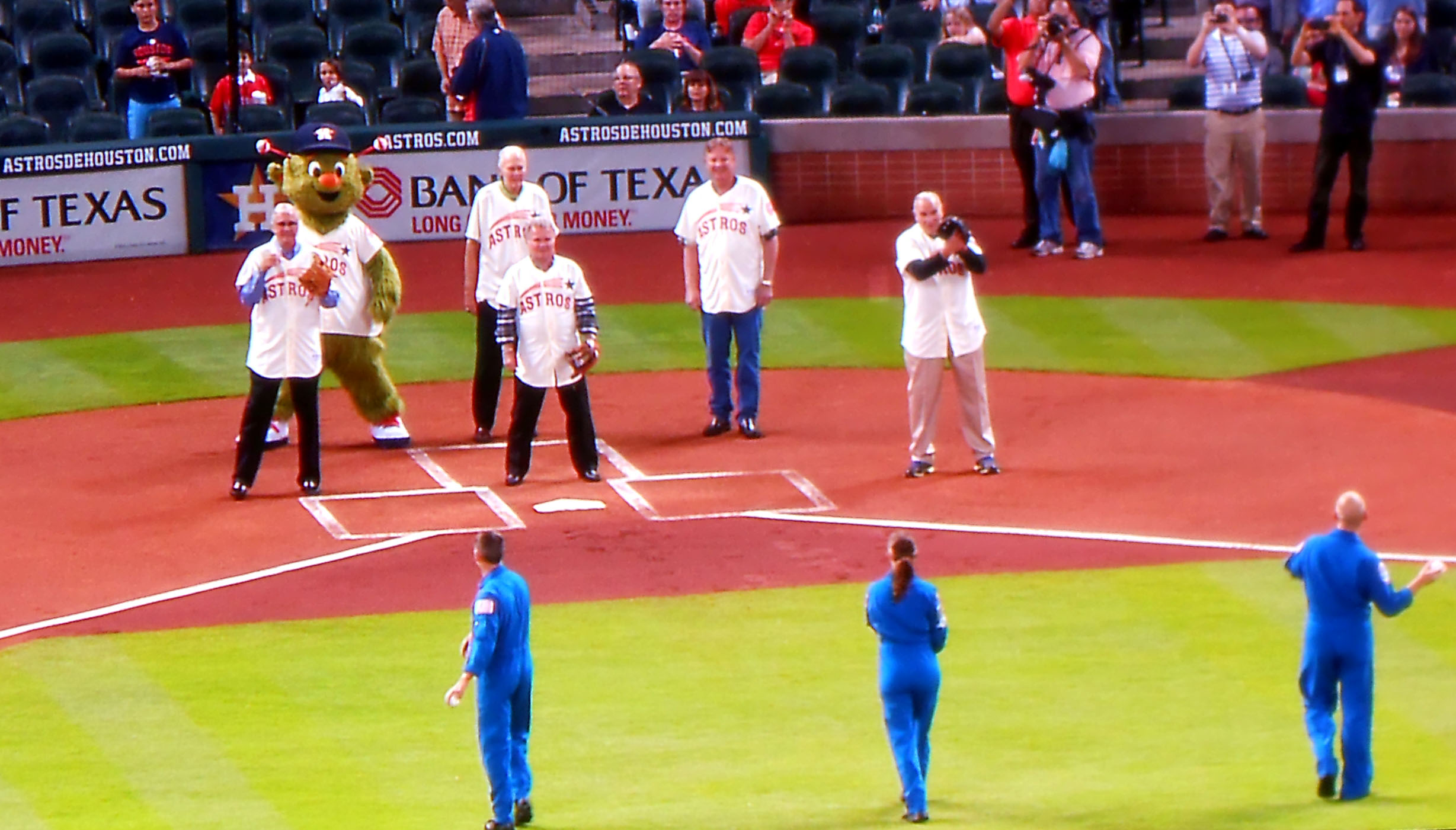
Saturday's Houston Astros game started with three astronauts throwing out ceremonial pitches and ended with a frantic search for a lost wallet. Photo R. Anderson
Saturday’s Houston Astros game started with three astronauts throwing out ceremonial pitches and ended with a frantic search for a lost wallet.
Photo R. Anderson

For some unknown reason during a recent visit to Minute Maid Park, my wallet decided that it no longer wanted to be in my pocket and decided to venture out on its own.

I did not realize that my wallet had gone on a walkabout until I was standing on the lower concourse after leaving my seat on the upper concourse.

Upon first realizing that my wallet was no longer tucked safely inside my pocket, my first thought was that perhaps I had been the victim of a pick pocket since several people had bumped into me during my trek through the mass of humanity within the facility.

My next thought regarding my lost wallet was that perhaps I was not the victim of a pick pocket and instead it had fallen out somewhere along my journey between the highest point of the Ballpark and the lowest.

Shortly after watching George Springer cross home plate after a solo home run I was greeted by the sinking feeling of an empty back pocket where my wallet should have been. Photo R. Anderson
Shortly after watching George Springer cross home plate after a solo home run I was greeted by the sinking feeling of an empty back pocket where my wallet should have been.
Photo R. Anderson

I decided that the only course of action was to retrace my steps and hope that the needle that was my wallet could be located within the hay stack that was Minute Maid Park.

As I began my sprint back to the upper deck, I allowed my thoughts to drift to the worst case scenario that at that very moment someone had my wallet and was up to no good.

While I was certainly not hoping for a worst case outcome, I knew that I needed to prepare myself in case that turned out to be what happened.

I knew that in this scenario whatever cash I had in the wallet was gone along with my driver’s license and credit cards.

There was nothing I could do about the lost cash, so I focused on the credit cards and who I would need to call to report the cards as stolen. While it would be a hassle to call them I knew that it was the only way to protect myself in the event the cards were stolen.

Ironically, it was not the potential loss of cash, nor the loss of the credit cards that had me the most upset.

The view of the grounds crew raking the field was nice. Sprinting from the lower bowl to the upper deck in record time was not quite as nice. Photo R. Anderson
The view of the grounds crew raking the field was nice. Sprinting from the lower bowl to the upper deck in record time was not quite as nice.
Photo R. Anderson

The thought that troubled me the most as I ran up the three sets of escalators, was that I was going to have to go to the Department of Motor Vehicles to get a new driver’s license.

It is sad that the DMV was the place I most dreaded, but as anyone who has spent an afternoon waiting in line can attest it really is a fate worse than lost cash or credit cards.

Speaking of the escalators, as I approached the usher at the top of the last one he looked briefly like he was going to tell me not to run but I must have had a look of either shear motivation or madness that told him to step aside and let me through.

Clearly I was a man on a mission.

About a hundred or so paces from the escalator was the tunnel that led to the section where my seat had been.

After turning the corner and entering the tunnel I saw another usher holding something brown that looked surprisingly like my walkabout wallet.

As I got closer I could tell that the light at the end of the tunnel, or in this case the brown object in the usher’s hand, was in fact my wallet.

The view from the top where a kind stranger helped ensure a wallet lost would be a wallet found. Photo R. Anderson
The view from the top where a kind stranger helped ensure a wallet lost would be a wallet found.
Photo R. Anderson

Although I was out of breath from my multilevel sprint I managed to utter the words, “That is mine, thank you.”

Without a word in return the usher gave me my wallet and I turned around to head back to the lower concourse.

All of the worst case scenarios that I had feared, including that trip to the DMV, were no longer in danger of coming to pass.

My wallet, complete with cash, credit cards and driver’s license was once again safely in my pocket.

I still do not know how my wallet managed to extradite itself from my pocket, nor do I know exactly who found it and gave it to the usher.

What I do know, is that someone in Section 410 of Minute Maid Park did the right thing and turned a situation that could have been very bad into something very good.

While I certainly don’t wish the stress of a sprint to find a lost wallet on anyone, sometimes it is those things that are needed in order to see the big picture.

Even though newspapers and television newscasts seem to be filled with only the stories of all of the bad things happening in the world, now and then it is important to be reminded that there are still good people in the world.

So to whoever found and returned my wallet last Saturday night I say, “thank you,” not only for the return of the wallet but for also showing a complete stranger an act of kindness and compassion.

Now if you’ll excuse me, I am off to buy some shorts with a Velcro closure on the back pocket to keep my wallet from further unapproved walkabouts.

Copyright 2015 R. Anderson

Astros Fan Fest Disappoints Once More

This past Saturday the Houston Astros hosted their annual Fan Fest.

Fan Fest is a time when fans can go to Minute Maid Park and take in the sights and sounds of the Ballpark before the team heads off to Florida for the start of Spring Training.

There are games for the kids and opportunities to take batting practice. There is even a chance to run around the bases like a Major League Baseball player.

Additionally, there are various state of the franchise forums where team management outlines their expectations for the upcoming season.

Fan Fest is also a place where fans can purchase player autographs, past promotional items and other things with the proceeds all going to the team’s charity.

Batting Practice is just one of the activites for fans during the Houston Astros Fan Fest. Photo R. Anderson
Batting Practice is just one of the activities for fans during the Houston Astros Fan Fest.
Photo R. Anderson

On the surface, Fan Fest is a win for everyone and is a great way to spend a sunny Saturday in January.

Unfortunately, much like the Astros players have a tendency to strike out at the plate, the past couple of Fan Fests have been mostly a swing and a miss from my perspective.

I have attended around six or seven Fan Fests through the years, and this was the second one that I had attended since the new ownership took over the team.

While I am sure there are still growing pains to address, I was really not too impressed with what I saw.

For the second year in a row, instead of letting fans move throughout the whole ballpark with activities spaced out, activities were limited to a U shape on the concourse which created log jams of humanity having to turn around and move back upstream like spawning salmon when they reached the two black curtain dams.

This meant that there was less elbow room than in past years, which made for a bit of a claustrophobic situation.

I am sure that there were many nice activities, but with so many people in such a small space it was hard to tell.

In the future, I would recommend spreading the activities out a bit more to avoid the packed sardine feel.

Another disappointment came in the annual garage sale of past promotional items.

In previous years, I have been able to get many team hats, shirts, and bobbleheads at the garage sale while doing my part to help charity.

This year when I arrived, the garage sale was already sold out of items. I find it very hard to believe that there were more people buying items this year to the point that they would be sold out an hour after the doors opened. I more likely scenario is that the team made less items available for the fans to purchase.

Speaking of things for fans to purchase, both team stores were open to allow people to stock up on hats, shirts and other gear ahead of the season.

The only problem with this was the proximity of the children’s bounce house zone to the store.

I have nothing against bounce houses, or even children inside bounce houses. My issue is with the proximity of the bounce house to the team store.

Anyone wanting to get to the main team store had to fight their way through lines of people waiting to get their bounce on.

There has got to be a better location for the bounce houses that allows the children to play and the adults to get to the store without having that salmon feeling again.

It is very likely that there were people who did not even go to the team store since they did not want to fight their way through bounce house land to get there. So, in this way, the placement of the bounce house zone likely cost the team money.

I did not venture to the Club level to hear any of the forums with team personnel since that would have been another upstream battle to get to the stairway that led to the forums.

In previous years, the fan forums were located in the Union Station lobby next to the team store and were easily accessible without battling the compressed humanity.

I am sure that the forums were good. I certainly wish I could have seen for myself, but it just wasn’t to be.

After two straight disappointing Fan Fest experiences, I will certainly think long and hard before returning next year.

I am sure I can find other ways to mark the arrival of the baseball season without swimming like a salmon with thousands of other fans crammed into a tight space.

Now if you’ll excuse me, all of this talk about salmon has me hungry for some seafood.

Copyright 2015 R. Anderson

Gas Prices are Falling, the Sky is Not

It has often been said that there are at least two sides to every story, and somewhere in the middle is the truth.

I have been thinking about that saying lately as I read the news coverage about the falling price of oil and gas, which depending on who you ask, is either the best thing ever for consumers, or the beginning of the end of western civilization as we know it.

There are many oil companies in and around Texas. When a gallon of gas was sold in the $3 to $4 range they were giddy and beside themselves as they swam Scrooge McDuck style in their big vaults of money.

To be perfectly honest, oil companies probably do not have a big money vault, but if they did there is no doubt that they were swimming in it like a Disney duck in a top hat.

With the average price of a gallon of gas below $2, and falling, many oil and gas companies are   shedding employees as they try to stay competitive in a changing market. Photo R. Anderson
With the average price of a gallon of gas below $2, and falling, many oil and gas companies are shedding employees as they try to stay competitive in a changing market.
Photo R. Anderson

Now, that the average price of a gallon of gas is below $2, and falling, those same companies are screaming that the only way they can remain in business at such low prices is by shedding employees as they try to stay competitive in a changing market.

Former oil executives are also telling anyone who will listen that the price of oil will soon rise again much like the phoenix rising from the ashes and that $5 a gallon gas is coming.

All the while, the bulk of the country finds more money in their pockets since the price to fill up at the pump is dropping.

More money not going to gas means more money available to spend on other things. Common sense says in theory more money in people’s pockets should help the economy.

Restaurants and other retailers should benefit from consumers spending less money in gas to arrive at their establishments.

Plus, companies spending less on gas to ship items means they are less likely to need to pass the costs on to those same consumers.

While I do not have an advanced business or economics degree, it seems a very simple equation that lower fuel costs are good and higher fuel costs are bad.

When I first started driving many years ago, gas was still under $1 a gallon.

I remember the uproar when gas stations had to add the third number on their signs when the price of a gallon of gas had the audacity to cost more than a buck.

The rumblings continued each time gas surpassed another dollar milestone as people dug deeper into their wallets each time they went to the pump as $3 and even $4 gas became a part of life.

The only people who would benefit from $5 a gallon gas also happen to be the only ones saying that it is coming. I guess they are hoping for a self-fulfilling prophecy.

Of course, gas is not the only factor affected by the laws of supply and demand.

Prices are higher when demand is great and supplies are low.

Conversely prices tend to drop when supplies raise and demand drops.

The factors of supply and demand are not limited to just oil commodities and play a role in the world of baseball as well.

When a team is red hot and demand to see them in person is high, the prices go up. When a team is struggling in the standings and the turnstile prices usually do not go up.

Under dynamic pricing fans are charged more to see the Boston Red Sox and New York Yankees compared with other teams where demand is not as great. Photo R. Anderson
Under dynamic pricing fans are charged more to see the Boston Red Sox and New York Yankees compared with other teams where demand is not as great.
Photo R. Anderson

Teams call this the dynamic pricing model. In Houston, the Astros use this practice to raise the price of admission whenever the Yankees and Red Sox come to town since they know that more people want to see those games and are willing to pay the higher prices.

Personally, I have always thought that the same seat in a Ballpark should cost the same amount of money regardless of who the opponent is.

However, it seems that dynamic pricing is here to stay as teams try to find ways to make as much money as they can by pricing differently depending on who the butts in the seats are watching.

Ticket prices are just one of many factors that go into the makeup of a competitive baseball franchise, just as the price of a gallon of gas is just one of the factors that drives the economy.

Falling gas prices will not doom the economy, and baseball fans will still pony up the dough if they want to see a team bad enough.

So, with Spring Training around the corner, it is time to take advantage of the low gas prices and take a road trip to see the action at the Ballpark.

Just don’t be surprised if you see oil executives in fancy suits on the side of the road holding up their sky is falling signs along the way.

After all, those private jets won’t pay for themselves.

Now if you’ll excuse me, I have a Spring Training trip to plan.

Copyright 2015 R. Anderson

Once Again Barry Bonds And Roger Clemens are on the Outside Looking in

The other day, it was announced that four players had been selected as Baseball Hall of Fame class of 2015 inductees.

Three of the inducted players were making their first ballot appearance, while the fourth was elected on his third year on the ballot after missing induction by two votes last year.

While the four elected players represented the largest induction since 1955, once again players who were deemed tainted by the steroid era in baseball were left on the outside looking in.

In fact, several of the roughly 500 men and women who comprise the voting members of the Baseball Writers’ Association of America (BWAA) have gone so far as to say that they will not vote for any players who spent their careers in the steroid era; regardless of whether or not they ever failed a drug test.

In taking this stance, the “anti any whispers of steroid use” voters cite the character clause in the Hall of Fame selection process as their reasoning for boycotting players from the so-called steroid era of baseball.

And speaking of the character clause that seems to be so en vogue with certain voters, are we to believe that every member of the Hall of Fame was an Eagle Scout and a scholar off of the field?

There can be character clause cases made against a number of the titans of the game who currently reside in the hallowed halls of Cooperstown.

Two players currently caught in the crossfire of the character clause point of view are Barry Bonds and Roger Clemens.

I grew up watching both players. Aside from a collection of baseball cards with their likeness on them, I was also fortunate to see both players in action at Minute Maid Park.

Barry Bonds, shown in plastic figurine form, was once again passed over for the Hall of Fame along with several other players who were believed to have used banned substances. Although known of the players were shown to be dirty some voting members of the BWAA refuse to vote for anyone who played during the so called steroid era regardless of what was or was not proven against them. Photo R. Anderson
Barry Bonds, shown in plastic figurine form, was once again passed over for the Hall of Fame along with several other players who were believed to have used banned substances. Although known of the players were shown to be dirty some voting members of the BWAA refuse to vote for anyone who played during the so called steroid era regardless of what was or was not proven against them.
Photo R. Anderson

While neither Bonds nor Clemens would be the type of athlete I would want to emulate off of the field based on the amazing egos both men seem to possess, by all accounts, those very same egos drove them throughout their careers and should have made them locks for first ballot induction to the Hall of Fame.

Both men had lengthy careers and put up the type of numbers that made a statistician blush and opposing players and fans curse.

Unfortunately late in their careers, both Bonds and Clemens were caught up in the net of suspicion regarding performance enhancing drugs, or PEDs, and were brought in front of a congressional subcommittee to face charges that they lied about their use of PEDs.

Despite both men being acquitted of the charges against them, and with Hall of Fame caliber numbers, they still are not in the Hall of Fame despite calls from more than 75 percent of fans to let them in.

This year, only a third of the guardians of the gate with their golden ticket votes determined that Bonds and Clemens are Hall of Fame worthy.

With only a few more years left on the ballot, it is entirely possible that two of the best players of their era will be on the outside looking in when it comes to the Baseball Hall of Fame.

And therein in lies the rub and the disconnect related to Hall of Fame voting.

The Hall of Fame is decided by around 500 people who have been BWAA members for at least 10 years.

There is no requirement that they ever played the game, but merely that they have covered the game as members of the media who have paid their club dues for 10 years.

Another wrinkle in the BWAA rules is that only 10 people can be included on any given ballot despite there being more than 10 eligible players each year.

I am not suggesting that the Hall of Fame turn into a sort of American Idol situation where fans can call in their votes for their favorite players.

But, I am also not sure that allowing 500 members of the media, who have different philosophies on what constitutes a tainted player, should be the only people guarding the gates of Cooperstown and determining who is in and who is out.

In all likelihood I will never be a member of the BWAA, nor will I ever cast a Hall of Fame ballot.

But if I were able to ever cast a ballot I would be sure to do my homework on the players and consider their numbers as a whole and not in a vacuum. I would also not use my vote as some sort of political platform.

If steroids were as widespread as Jose Canseco and others would have us believe, than the playing field was level in a certain way in that the numbers put up by players during that era were against other “enhanced” players so they should not be banned from the Hall of Fame, especially if no proof exisits that they ever took banned substances. Photo R. Anderson
If steroids were as widespread as Jose Canseco and others would have us believe, than the playing field was level in a certain way in that the numbers put up by players during that era were against other “enhanced” players so they should not be banned from the Hall of Fame, especially if no proof exists that they ever took banned substances.
Photo R. Anderson

For example, if steroids were as widespread as Jose Canseco and others would have us believe, than the playing field was level in a certain way in that the numbers put up by players during that era were against other “enhanced” players.

And by all means, with players such as Bonds, Clemens and others who never failed a drug test for any substance banned by Major League Baseball, one cannot ban them from the Hall of Fame because they might have been dirty.

I might have run a red light today, or I might not have.

Should I get randomly pulled over by a police officer and given a ticket just because at some point when no one was looking I may have run a red light? Of course not.

That would be overstepping the authority of the police and go against the letter of the law that one is innocent until proven guilty.

Players need to be judged on their on-field performance and if their numbers support admission they need to be admitted.

Yes, there was a time when the game of baseball was riddled with steroids. However, it was not the only time in the history of the game where players sought to get an edge.

Are we supposed to go through all the way back to Babe Ruth and others to determine if their numbers were enhanced through supplements? No we are not.

I am glad that drug testing is part of the sport, and I do hope that the use of steroids can be contained. However, players always have and always will look for an off the field edge to help their on the field performance.

The practice of using some vague interpretation of the character clause as a way to deny admission to players who have been found guilty of no crime except being guilty by association needs to be stopped.

Unless a player drops their pants at home plate Forrest Gump meeting LBJ style and injects steroids into their buttocks in front of 35,000 witnesses, we need to give them the benefit of the doubt.

Players with a Hall of Fame career deserve their proper enshrinement in bronze if they have never failed a drug test.

Now if you’ll excuse me, all of this talk about baseball and foreign substances that shouldn’t be injected into a body has me craving a hot dog.

Copyright 2015 R. Anderson